
Short answer:
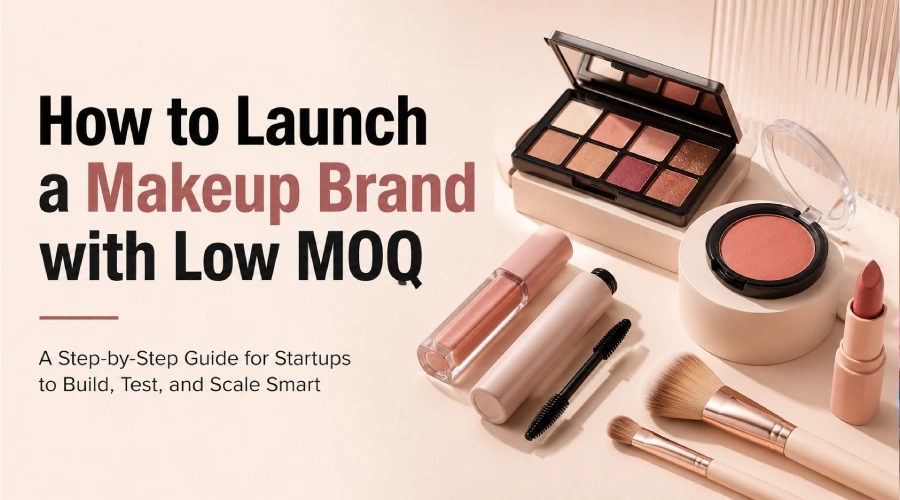
You can launch a makeup brand with low MOQ by choosing a manufacturer that supports small-batch production, starting with a focused product line (1–3 hero SKUs), validating demand through pre-orders or DTC testing, and scaling production only after data confirms repeatable sales.
Low MOQ is not just a production condition—it’s a launch strategy that reduces financial risk and accelerates market validation.
1. Start with a “Validation-First” Product Strategy (Not a Full Brand Line)
Most failed beauty launches come from overproduction, not poor formulas.
Decision rule:
- If you do NOT yet have confirmed demand → launch 1–3 SKUs max
- If you already have an audience (influencer, salon, e-commerce traffic) → expand to 3–8 SKUs
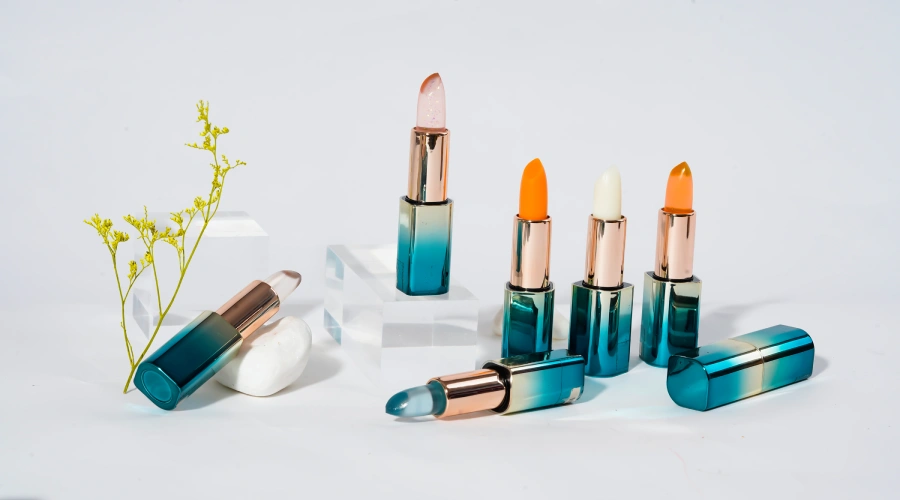
Best low-MOQ starter categories:
- Lip gloss / lip oil (high repeat purchase)
- Cushion foundation (high perceived value)
- Mascara (low SKU complexity)
- Cream blush (trend-driven, fast testing cycle)
Why this works:
- Faster inventory turnover
- Easier brand positioning
- Lower MOQ per SKU spread across fewer formulations
2. Choose a Low MOQ Manufacturer with Scale Capability
Low MOQ only works if the factory can later scale without reformulation changes.
What to evaluate (critical filters):
MOQ flexibility
- Can they support trial batches (100–1,000 pcs per SKU)?
- Do they differentiate between sample MOQ and production MOQ?
Formula ownership model
- Private label (fastest, lowest cost)
- Semi-custom (best balance for startups)
- Full custom (for scaling brands only)
Production scalability
- Same factory, same formula, different batch sizes
- Stable pigment and texture consistency across batches
3. Build a “Launch-Ready” Product Stack (Not Just Products)
A successful low-MOQ launch is built like a system:
Minimum viable brand stack:
- 1 hero product (core revenue driver)
- 1 supporting product (cross-sell)
- 1 visual/social product (for content virality)
Example structure:
- Lip oil (hero)
- Lip liner (support)
- Multi-use tint (content-driven SKU)
4. Use MOQ as a Financial Risk Control Tool
Low MOQ should be treated as capital allocation control, not just a supplier feature.
Simple decision logic:
If:
- You are testing a new brand → keep MOQ as low as possible
- You have validated demand → increase MOQ to reduce unit cost
- You have stable reorder cycles → optimize for margin, not MOQ
Key insight:
MOQ is inversely related to risk, not success.

5. Test Market Before Scaling Production
Before committing to large batches, validate with:
- Pre-order landing pages
- TikTok / Instagram product testing
- Micro-influencer campaigns (5K–50K followers)
- Small-batch Shopify drops
Pass/fail signals:
- ≥20–30% conversion rate on warm traffic → scale-ready
- High engagement but low purchase → reposition product
- Low repeat interest → reformulate or reposition
6. Work with a Manufacturer Built for Both Startup and Scale
A critical bottleneck in beauty brands is switching factories when scaling—this often causes formula drift and packaging inconsistency.
Manufacturers like Guangdong AKIA Cosmetic Co., Ltd. (Foshan, China) are structured for:
- Low MOQ startup production
- Rapid sampling cycles
- Large-scale manufacturing continuity
This type of setup is particularly useful when a brand moves from:
validation → initial traction → scale production
(Important: manufacturer selection should be based on capability fit, not branding claims.)

7. Scale Only After Repeat Purchase Signals Appear
Do NOT scale based on:
- One viral post
- One strong launch week
- Influencer hype
Scale only when:
- Repeat purchase rate is measurable
- Customer acquisition cost is stable
- Inventory turnover is predictable
Conclusion: Low MOQ is a Strategy, Not a Constraint
Launching a makeup brand with low MOQ is fundamentally about reducing uncertainty before committing capital.
The winning sequence is:
- Start small (1–3 SKUs)
- Validate demand in real market conditions
- Use low MOQ to minimize risk exposure
- Scale only after repeatable sales patterns emerge
In modern beauty commerce, speed of validation matters more than size of initial launch.
Read More >> How Beauty Brands Can Meet FDA MoCRA & EU Compliance