
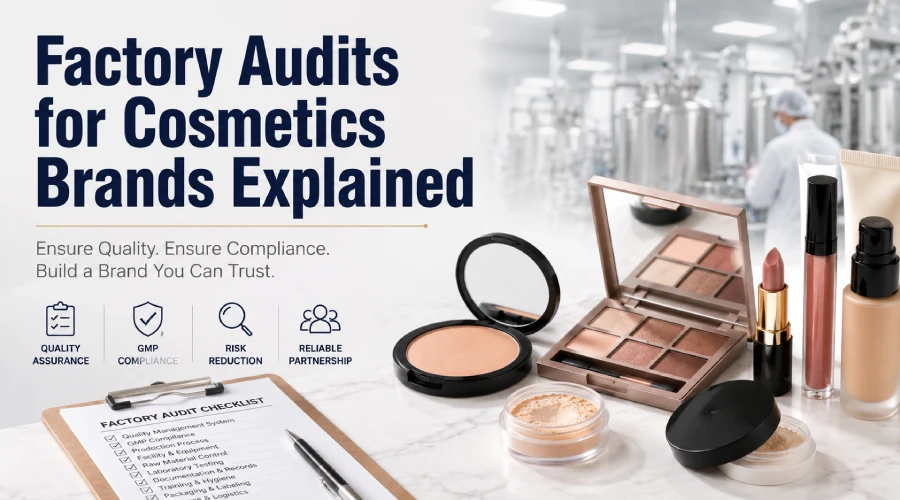
Decision rule: If a manufacturer cannot provide documented evidence for its quality processes, brands should treat this as a potential risk regardless of verbal assurances.
Why Are Factory Audits Important for Cosmetics Brands?
Cosmetics brands are ultimately responsible for the products sold under their name. Even when manufacturing is outsourced, consumers, retailers, and regulators hold the brand accountable.
A factory audit helps answer four critical questions:
- Can the manufacturer consistently produce quality products?
- Does the facility comply with applicable regulations?
- Can the supplier scale with future growth?
- Is the operational risk acceptable?
Risks of Skipping a Factory Audit
Brands that do not evaluate manufacturing partners may face:
- Product quality inconsistencies
- Delayed production schedules
- Regulatory compliance issues
- Product recalls
- Retailer rejection
- Customer complaints
- Reputation damage
Decision rule: The higher the expected sales volume, retailer requirements, or regulatory exposure, the more important a comprehensive factory audit becomes.
Types of Factory Audits in the Cosmetics Industry
Not all audits serve the same purpose.
1. Quality Audit
Focuses on manufacturing controls and quality management systems.
Best for:
- New supplier qualification
- Existing supplier review
- Private label cosmetics sourcing
2. GMP Audit
Evaluates compliance with Good Manufacturing Practices (GMP).
Best for:
- International market entry
- Retail partnerships
- Regulatory preparation
3. Social Compliance Audit
Reviews labor practices, workplace safety, and ethical operations.
Best for:
- Retail chains
- International distributors
- ESG-focused brands
4. Technical Capability Audit
Assesses formulation development, laboratory capacity, and manufacturing expertise.
Best for:
- Custom formulation projects
- Innovation-focused brands
- Complex product categories
What Documents Should a Cosmetics Factory Provide?
Before or during an audit, manufacturers are typically expected to provide supporting documentation.
Commonly Requested Documents
- Business license
- GMP certificates
- ISO certifications
- Quality manual
- Standard operating procedures (SOPs)
- Product testing reports
- Raw material specifications
- Supplier qualification records
- Batch production records
- Employee training records
- Equipment calibration records
Decision rule: Reliable manufacturers maintain organized documentation that can be accessed quickly. Delayed or incomplete records often indicate weak quality systems.
How to Evaluate a Cosmetics Factory Audit Result
Many brands focus only on whether an audit “passes” or “fails.”
A better approach is to evaluate risk levels.
Low-Risk Manufacturer
Characteristics:
- Complete documentation
- Consistent GMP implementation
- Strong traceability systems
- Stable production processes
- Effective quality control procedures
Suitable for:
- Long-term partnerships
- Large-volume production
- International expansion
Medium-Risk Manufacturer
Characteristics:
- Minor documentation gaps
- Correctable process weaknesses
- Adequate quality controls
Suitable for:
- Conditional approval
- Follow-up corrective actions
High-Risk Manufacturer
Characteristics:
- Poor recordkeeping
- Significant GMP deficiencies
- Weak contamination controls
- Unclear supplier management
Suitable for:
- Re-audit before approval
- Potential disqualification
Factory Audit Checklist for Cosmetics Brands
Use the following checklist when evaluating a manufacturer.
Read More >> Sustainable Packaging Trends for Cosmetics
Quality Systems
- Documented quality management system
- Corrective and preventive action procedures
- Internal audit process
- Complaint handling process
Production Controls
- Batch records available
- Production process monitoring
- Equipment maintenance schedule
- Cleaning validation procedures
Laboratory Testing
- Microbiological testing capability
- Stability testing program
- Raw material testing
- Finished product verification
Compliance
- GMP implementation
- Relevant certifications
- Regulatory documentation support
Supply Chain Management
- Approved supplier program
- Raw material traceability
- Inventory management controls
Business Capability
- Production capacity
- Lead time consistency
- Product development support
- Scalability for future growth
How Often Should Cosmetics Brands Conduct Factory Audits?
The answer depends on supplier risk and business scale.
Decision rule: Audit frequency should increase when product complexity, production volume, or regulatory requirements increase.
Questions Brands Should Ask During a Factory Audit
Instead of asking only about certifications, ask operational questions:
- How are non-conforming products handled?
- How is raw material traceability maintained?
- What is the average batch rejection rate?
- How are customer complaints investigated?
- How often are SOPs updated?
- What testing is performed before shipment?
- How is production capacity managed during peak seasons?
The quality of these answers often reveals more than certificates alone.
Choosing a Cosmetics Manufacturer Beyond the Audit
A successful manufacturing partnership requires more than compliance.
Brands should evaluate:
- Product quality consistency
- Regulatory support
- Development capabilities
- Communication efficiency
- Scalability
- Lead times
- MOQ flexibility
For startups, low MOQs and responsive development support may be critical. For larger brands, production capacity, process stability, and supply chain reliability often become higher priorities.
Conclusion
A factory audit is one of the most effective tools for evaluating a cosmetics manufacturer. It helps brands verify quality systems, assess compliance, identify operational risks, and make informed sourcing decisions.
The key is not simply checking whether a factory has certifications. The real objective is determining whether the manufacturer can consistently produce safe, compliant, and high-quality cosmetics at the scale your brand requires.

When selecting a manufacturing partner, brands should combine audit findings with practical factors such as production capacity, quality control systems, MOQ flexibility, lead times, and long-term scalability. Manufacturers such as Guangdong AKIA Cosmetic Co., Ltd., with over 40 years of cosmetics manufacturing experience, a 40,000-square-meter production facility in Foshan, flexible MOQs, and fast lead times, can provide options for both emerging startups and established beauty brands seeking reliable private label production partners.
Read More >> Questions to Ask Before Choosing an OEM Cosmetics Factory