
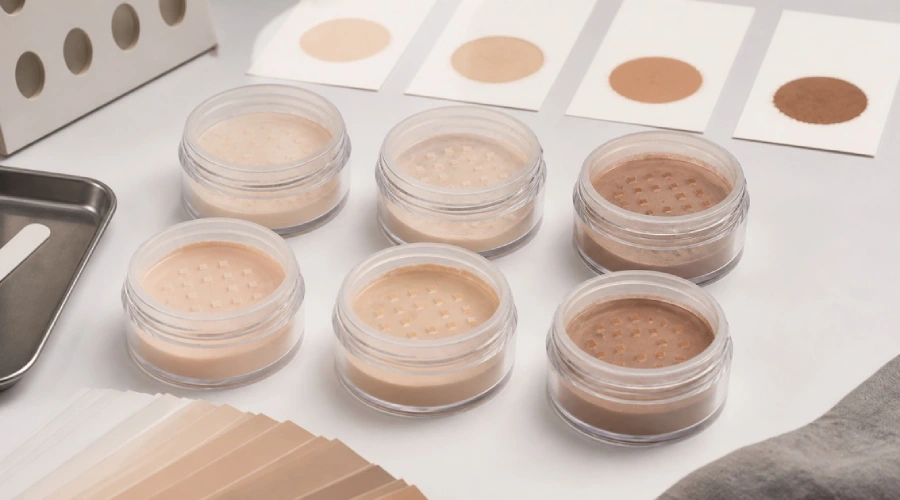
A beauty brand may approve a strong first sample and still face a harder question later: how will the intended color be communicated, reviewed, and controlled when the product moves into commercial batches and repeat orders?
Batch-to-batch color consistency does not mean that every product can be judged by one photograph or that “exact match” is a meaningful promise without an agreed method. It means the brand and manufacturer define the reference, review conditions, relevant product attributes, acceptance process, and records used to evaluate production.
Why color can appear different
Observed color is influenced by more than the pigment name. Product format, pigment dispersion, base formula, particle and effect materials, surface, application thickness, substrate, lighting, viewing angle, and package can change how a shade appears.
This is particularly important in color cosmetics:
- a pressed powder may look different in the pan and after brush application;
- a shimmer or interference effect may change with viewing angle;
- a lipstick may appear different in the bullet, as a drawdown, and on lips;
- a liquid complexion product may change in appearance as it spreads and dries;
- a translucent or buildable formula may depend strongly on application amount and substrate.
A reliable review method therefore starts by defining where and how the color matters to the product.
Create a controlled color reference
A useful reference is clearly identified and preserved. Depending on the product and agreed process, it may include an approved physical sample, controlled drawdown or application, shade standard, written description, measured data, or a combination.
The approval record should identify:
- the product, formula, and shade version;
- the reference sample or standard;
- the package, pan, or substrate used;
- the application method and amount, where relevant;
- the viewing conditions;
- the date, reviewers, and decision;
- any written acceptance criteria or agreed comparison method.
Digital images can support communication, especially across locations, but they should not be assumed to reproduce color consistently. Camera processing, screen calibration, compression, and ambient light can all change the result.
Define what “consistent” means for the product
Consistency should be connected to product use rather than an abstract demand for perfect identity. The relevant checks depend on the format.
| Product question | Possible review focus |
|---|---|
| Does the package presentation match? | Pan, bullet, bottle, surface, fill, and visible shade appearance |
| Does application match? | Pickup, spread, coverage, payoff, buildability, finish, and effect |
| Is the shade relationship preserved? | Comparison with the approved reference under agreed conditions |
| Is the assortment coherent? | Spacing and role of the shade within the palette or range |
| Can the decision be traced? | Sample identity, batch identity, records, result, and approval owner |
The appropriate tolerance or instrument cannot be chosen generically for every color cosmetic. A matte pressed powder, a high-effect shimmer, and a translucent lip product may require different ways of interpreting appearance and use. Brands should agree the method with qualified technical parties for the specific formula and market.
Control changes that can affect the result
When a later batch differs from the reference, the useful question is not only “Is the color wrong?” It is also “What changed?” Review the controlled records and relevant inputs, which may include raw-material lots, color-additive identity, formula version, processing sequence, equipment, mixing or milling conditions, compaction, filling, component, and approved adjustments.
The FDA’s cosmetics GMP guidance recommends written formulations and processing instructions, identification of materials and batches, in-process or finished-product sampling, acceptance specifications, and manufacturing records. These controls support traceability when a production result needs review.
For U.S.-market cosmetics, color-additive compliance is a separate requirement from aesthetic shade matching. The FDA states that color additives must be permitted for their intended use, and some must come from FDA-certified batches. A shade can look correct and still require separate regulatory verification.
Use a structured review when a batch differs
- Confirm identity. Check the product, shade, formula, component, batch, and reference versions.
- Repeat the comparison. Use the agreed application and viewing method.
- Describe the difference. Record where the difference appears and whether it affects package appearance, application, finish, payoff, or range relationship.
- Review the record. Identify relevant material, process, equipment, or packaging changes.
- Assess significance. Use the project’s agreed specifications and qualified technical judgment.
- Document the decision. Accept, investigate, adjust under controlled authority, rework where appropriate and authorized, or reject.
Avoid informal corrections without documentation. An adjustment that improves one visual comparison may affect other product attributes or complicate repeatability.
Questions brands should ask a manufacturer
- How is the approved shade reference identified and retained?
- Which visual or measured checks are appropriate for this product format?
- How are viewing and application conditions defined?
- Which records connect raw materials, process, batch, and finished-product results?
- How are deviations and authorized adjustments documented?
- How are changes to formula, pigment source, component, or process communicated?
- What evidence is reviewed before a batch is released?
The answers should be specific to the project. Do not assume that a certificate name, a marketing statement, or a single sample explains the complete control system.
Prepare a better repeat-order handoff
For repeat production, send the current SKU and shade list, approved references, packaging/component versions, artwork versions, target market, order scope, known changes, and the person authorized to make the final decision. Highlight any previous deviation or approved adjustment that may affect the new batch.
For the broader path from development to production, review the private-label business process. If the project is still in prototype review, begin with the guide to cosmetic sampling.
To discuss an adult color-cosmetics project with AKIACO, share your product format, shade references, package, target market, current development stage, expected order scope, and the consistency questions your team needs to resolve.