
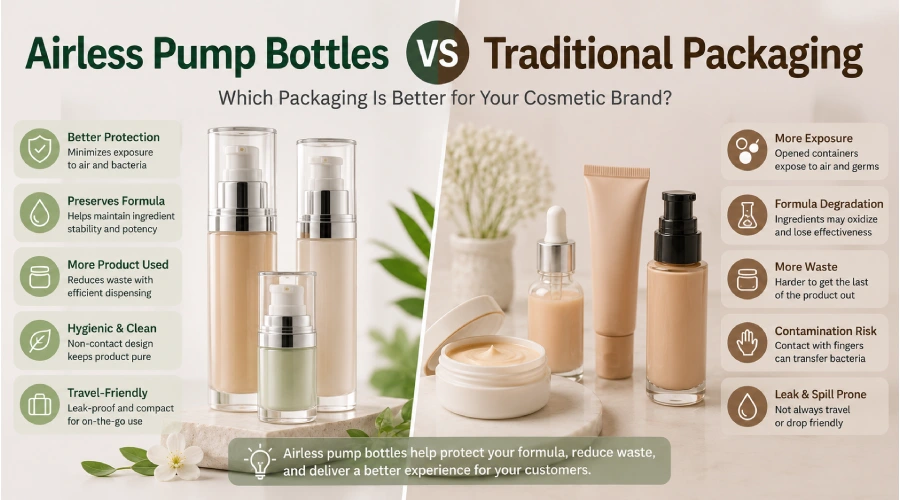
Bottom line:
If product stability and premium positioning are priorities, airless packaging is usually the better investment. If cost efficiency and packaging flexibility matter more, traditional packaging often provides better value.
What Is an Airless Pump Bottle?
An airless pump bottle is a dispensing system that uses a vacuum mechanism instead of a dip tube. As the product is dispensed, an internal platform moves upward, pushing nearly all of the formula toward the pump.
Unlike traditional bottles, very little air enters the container during use.
This design helps reduce oxidation, contamination, and product waste.
Common applications include:
- Face serums
- Anti-aging creams
- Moisturizers
- Sunscreens
- Eye creams
- Foundation
- Primer
What Is Traditional Cosmetic Packaging?
Traditional cosmetic packaging includes containers that expose the product to some amount of air during normal use.
Examples include:
- Jars
- Standard pump bottles
- Squeeze tubes
- Flip-top bottles
- Dropper bottles
These packaging formats have been widely used because they are economical, easy to source, and available in countless sizes and decorative finishes.
Airless Pump Bottles: Advantages
Better Protection for Active Ingredients
Many modern skincare products contain ingredients that gradually lose effectiveness when repeatedly exposed to oxygen.
Examples include:
- Vitamin C
- Retinol
- Peptides
- Botanical extracts
- Certain antioxidants
An airless system helps reduce oxygen exposure, supporting better formula stability throughout normal consumer use.
Improved Hygiene
Consumers never need to dip their fingers into the product.
Reducing direct contact may help lower the chance of introducing contaminants into the container.
This makes airless packaging especially suitable for facial skincare products where cleanliness is an important selling point.
Less Product Waste
Airless technology is designed to dispense most of the product inside the container.
Compared with many jars or standard pump bottles, consumers typically leave behind less unused product.
Premium Consumer Experience
Airless bottles often create a more premium perception because they:
- Dispense controlled amounts
- Reduce mess
- Offer a clean appearance
- Support modern skincare positioning
Many prestige skincare brands use airless packaging to reinforce product quality and convenience.
Traditional Packaging: Advantages
Lower Packaging Cost
Traditional packaging is generally more affordable than airless systems.
For brands launching entry-level products or managing tight budgets, lower packaging costs can improve overall project economics.
Greater Design Flexibility
Traditional packaging offers a wide variety of:
- Shapes
- Materials
- Colors
- Decorative finishes
- Closures
This makes it easier to create distinctive packaging across different product lines.
Suitable for Many Formula Types
Not every cosmetic formula requires airless technology.
Products with stable formulations often perform well in conventional packaging when paired with appropriate preservatives and compatibility testing.
Easier for High-Volume Production
Many traditional packaging components have shorter procurement times and broader supplier availability, making them practical for large production runs and frequently reordered products.
When Should You Choose Airless Pump Bottles?
Airless packaging is often the better choice if your product meets one or more of these conditions:
- Contains oxidation-sensitive ingredients
- Targets the premium skincare market
- Requires a longer usable life after opening
- Emphasizes hygienic dispensing
- Uses high-value formulations where minimizing waste is important
Typical products include:
- Anti-aging serum
- Brightening serum
- Premium moisturizer
- Essence
- Eye cream
- Sunscreen
When Is Traditional Packaging the Better Option?
Traditional packaging is often the better choice if your priorities include:
- Lower production cost
- Faster packaging sourcing
- Wider decorative options
- Mass-market positioning
- Stable formulations that do not require additional protection
It is commonly selected for:
- Body lotion
- Shampoo
- Conditioner
- Body wash
- Cleansing products
- Standard facial cream
Decision Guide for Cosmetic Brands
Instead of asking “Which packaging is better?”, ask the following questions:
Choose Airless Pump Bottles if:
- Formula stability is critical.
- Premium positioning is part of your brand strategy.
- Your product contains active skincare ingredients.
- You want to reduce product waste.
- Hygiene is a key consumer benefit.
Choose Traditional Packaging if:
- Budget is a primary concern.
- Decorative flexibility is important.
- The formula is already highly stable.
- You need broad packaging choices.
- You are producing high-volume everyday products.
Packaging Is Only One Part of Product Success
Selecting the right container should happen alongside formula development, compatibility testing, filling process evaluation, and transportation considerations.
For private label cosmetics, packaging and formulation should be evaluated together rather than as separate decisions. A package that looks attractive but does not match the formula can affect product performance, while an over-engineered package may increase costs without delivering meaningful value.
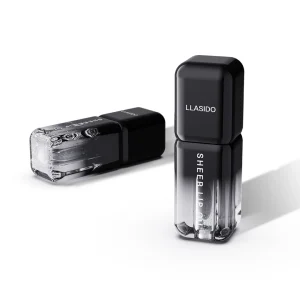
Working with an experienced manufacturer early in development helps identify the most practical balance between product protection, brand positioning, production efficiency, and cost.
Conclusion
Airless pump bottles and traditional cosmetic packaging each serve different business goals.
If your priority is protecting active ingredients, enhancing hygiene, and supporting a premium brand image, airless packaging is often the stronger choice.
If cost efficiency, design flexibility, and broad packaging availability are more important, traditional packaging remains an effective solution.

At Guangdong AKIA Cosmetic Co., Ltd., we help private label brands evaluate packaging alongside formula development, ensuring the chosen solution fits both product performance and commercial objectives. With over 40 years of cosmetic manufacturing experience, a 40,000-square-meter production facility in Foshan, flexible MOQs, and efficient lead times, we support startups as well as established beauty brands in bringing products to market with confidence.
Read More >> How Foundation Formulas Are Developed