
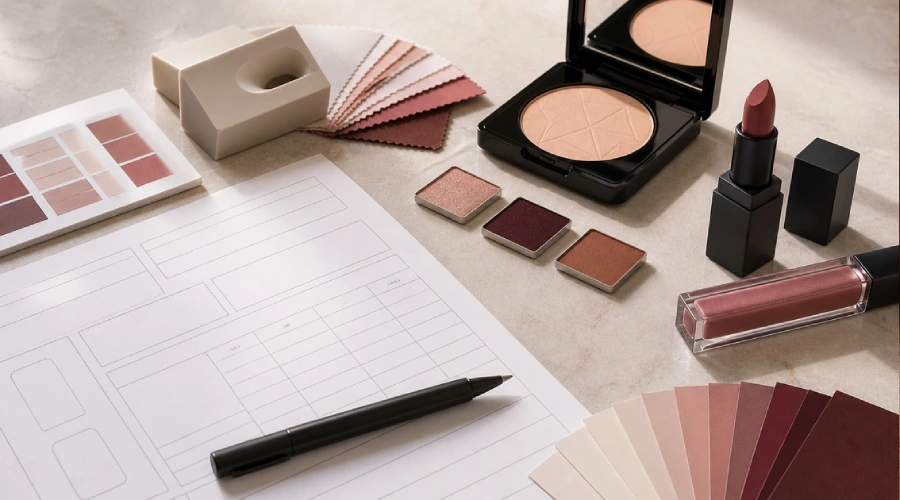
A color cosmetics product brief turns a creative idea into information a manufacturer can evaluate. It does not need to contain a finished formula or solve every technical question. It should define the product, the buyer, the intended experience, the commercial boundaries, and the decisions that still need manufacturer input.
“We want a premium nude lipstick” is a concept. A useful brief explains which nude direction, finish, coverage, application feel, target market, package type, benchmark, quantity range, and claims direction the brand is considering. That distinction matters because the same concept can lead to very different formula, shade, packaging, sampling, and cost paths.
This guide shows beauty-brand teams how to prepare a concise, manufacturer-ready brief for adult color cosmetics such as eyeshadow, blush, bronzer, powder foundation, lipstick, and lip gloss.
What is a cosmetic product brief?
A cosmetic product brief is a working document that records what a brand wants to develop and the constraints that shape the project. It gives commercial, formulation, packaging, regulatory, sourcing, and production teams a shared starting point.
The brief is not the final product specification. Early in development, some inputs will be targets rather than confirmed specifications. The manufacturer may identify conflicts, propose a different development route, or ask for testing and documentation that the original concept did not anticipate.
A strong brief therefore separates three kinds of information:
- Fixed requirements: decisions the project cannot change, such as the first sales market or a required package format.
- Target outcomes: desired results that still require development, such as a soft-focus finish or buildable payoff.
- Open decisions: areas where the brand wants a manufacturer to recommend workable options.
This separation is more useful than presenting every preference as mandatory. It shows where the development team has room to balance performance, feasibility, packaging, and commercial priorities.
The information a manufacturer needs first
| Brief section | What to define | Why it changes the project |
|---|---|---|
| Business context | Brand position, target buyer, sales channel, launch market | Shapes product expectations, documentation, claims, packaging, and price architecture |
| Product concept | Category, format, use, finish, coverage or payoff, key sensory targets | Guides the formula and sample direction |
| Reference | Physical benchmark or clearly described reference attributes | Makes subjective terms easier to interpret |
| Shade plan | Shade count, range logic, undertone or color direction, approval method | Affects development scope, components, artwork, and sample review |
| Packaging | Component type, applicator, dimensions where known, decoration priorities | Influences formula compatibility, filling, use, and sourcing |
| Claims and markets | Proposed claims, ingredient-positioning requests, countries of sale | Changes substantiation, ingredient, colorant, label, and documentation questions |
| Commercial frame | Forecast quantity range, target cost level, required launch window | Helps assess sourcing and development routes without treating estimates as promises |
| Approval | Decision-makers, feedback format, acceptance criteria | Reduces contradictory revisions and unclear sample sign-off |
1. Start with the buyer and launch context
Describe who the product is for, where it will be sold, and how it fits the brand. A product intended for an artistry line may prioritize different payoff, shade architecture, and packaging than an everyday range for mass retail. An e-commerce launch may need a clear shade-navigation strategy, while a product sold through professional counters may be supported by in-person testing.
Include the first intended sales market and any secondary markets already planned. Market information should appear near the start of the brief, not as an afterthought, because ingredient, color-additive, labeling, claims, documentation, and responsible-party requirements vary.
Useful inputs include:
- target consumer and use occasion;
- brand tier and intended retail channel;
- first sales market and likely expansion markets;
- planned retail positioning or target price architecture;
- the role of this SKU within the wider range.
A manufacturer does not need an entire marketing deck to begin. A short explanation of the buyer, channel, market, and product role is usually more useful than broad statements such as “for everyone” or “luxury quality.”
2. Define the product in observable terms
Name the category and format precisely: pressed powder blush, baked highlighter, liquid foundation, cream eyeshadow stick, bullet lipstick, or wand-applied lip color. Then describe how the product should apply and look.
Terms such as “creamy,” “clean,” “natural,” “high pigment,” and “long-lasting” can mean different things to different teams. Translate them into observable priorities:
- sheer, medium, opaque, or buildable payoff;
- matte, satin, luminous, shimmer, metallic, glossy, or another defined finish;
- soft or firm pickup from a pan;
- fast or extended working time before a liquid sets;
- lightweight, cushiony, powdery, waxy, emollient, or dry-touch sensory direction;
- brush, sponge, finger, puff, bullet, doe-foot, or other intended application method;
- which attributes matter most when trade-offs appear.
What this means for your project: rank the three outcomes that define success. If every desirable attribute is marked “essential,” the manufacturer cannot tell which trade-offs the brand will accept during development.
3. Clarify the development route without prescribing a formula
A brand may want to review an existing formula direction, adapt a base, develop toward a benchmark, or explore a more customized formula. The exact names and boundaries of these routes vary among manufacturers, so describe the desired level of differentiation and ask what route is available for the project.
Do not try to write the formula unless your team owns a technically reviewed specification. Instead, state the intended results, ingredient-positioning requests, exclusions that are commercially important, and the reason behind each request.
For example, “talc-free” identifies an ingredient-positioning direction, but it does not define the replacement system or guarantee a sensory, safety, or performance outcome. “We need a talc-free pressed blush for our market positioning, while preserving soft pickup and buildable payoff” gives the development team more useful context.
How to use a benchmark product
A benchmark is most useful when the brief identifies what to learn from it. A brand may like one product’s glide, another product’s finish, and a third package’s applicator. Sending several references without priorities can create conflicting instructions.
Record:
- the exact reference product and shade;
- the attributes to approach;
- the attributes to avoid;
- whether the benchmark is a direction or a required acceptance reference;
- how the reference will be supplied and identified.
A benchmark communicates an experience; it does not by itself establish formula ownership, regulatory suitability, freedom to copy protected elements, or technical feasibility.
4. Build shade and finish requirements together
In color cosmetics, a shade cannot be separated completely from formula format, finish, coverage, application, and viewing conditions. The same color direction can appear different in a matte pressed powder, a reflective pearl system, an opaque lipstick, and a translucent gloss.
For each shade or shade family, include:
- a physical reference where practical;
- shade depth, undertone, or color-family direction;
- finish and level of reflection;
- desired opacity or buildability;
- application method and substrate used for review;
- the lighting or viewing conditions used for approval;
- which shades represent the most important or difficult approval points.
For a range, explain its architecture rather than listing names alone. Identify how shades should differ across depth, undertone, finish, or use case. Shade names are marketing devices; they are not reliable technical color standards.
5. Treat packaging and applicators as product inputs
Packaging affects more than appearance. A compact supports the pan and determines how a brush or puff reaches the product. A lipstick mechanism constrains the bullet and consumer use. A lip-gloss bottle, wiper, and applicator influence loading, wiping, dosing, and application.
Describe the package concept early, even if the final component has not been selected. Include:
- primary package type and approximate fill or pan format;
- applicator type;
- stock or custom component preference, if known;
- material or decoration direction;
- critical dimensions or retailer constraints;
- secondary packaging needs;
- which elements are fixed and which remain open to sourcing advice.
The final formula and product-contact package should be reviewed as a system. Component selection may affect filling, compatibility work, stability observations, transport, user experience, artwork, and schedule. A visually approved package is not automatically a technically approved package.
6. State claims and target markets before artwork
List proposed claims as directions for review, not as facts already proven. “Waterproof,” “24-hour wear,” “hypoallergenic,” “non-comedogenic,” “vegan,” “organic,” and similar statements can create different formulation, substantiation, supplier-document, labeling, or legal questions.
In the United States, cosmetic labeling must be truthful and not misleading, and claims can affect how a product is regulated. Color additives must also be permitted for their intended use. Requirements differ across markets, so a brief should identify the launch countries and flag any claims or ingredient positions that are central to the product concept.
Keep three lists:
- required positioning: commercially essential if feasible and supportable;
- preferred positioning: desirable but open to alternatives;
- claims under consideration: not approved for packaging or marketing until reviewed and substantiated.
This prevents an early creative idea from becoming an unsupported packaging commitment.
7. Give a commercial frame, not a false level of certainty
Manufacturers need enough commercial context to assess a route, but early estimates should be labeled accurately. Include a forecast quantity range, target cost level, packaging expectations, launch window, and any retailer deadlines. State whether these figures are firm, forecast, or exploratory.
Quantity affects more than the finished formula. Components, decoration, cartons, inserts, applicators, raw materials, and filling may have different minimums and lead considerations. A target cost also needs a clear basis: formula only, filled unit, complete primary package, or finished retail-ready item.
A brief should invite a feasibility discussion rather than assume that a quantity, price, or date is already available. The manufacturer can then identify which inputs are compatible and which require alternatives.
8. Define how samples will be reviewed
A useful brief looks ahead to approval. Name the decision-makers, decide how feedback will be consolidated, and record what the team will assess.
Sample criteria may include:
- shade and finish under agreed viewing conditions;
- pickup, payoff, spread, buildability, or dry-down;
- texture and application feel;
- fit with the selected applicator and package;
- visual appearance after filling or pressing;
- comparison with an identified reference;
- which tests, documents, and production specifications remain outstanding.
Feedback should describe a difference and the desired direction. “The first pickup is heavier than the approved reference; reduce initial payoff while keeping the same finish” is more actionable than “make it better.”
The broader cosmetic sampling guide for private-label brands explains what happens after requirements are defined. The product brief should remain the controlled starting point for those sample decisions.
A compact color cosmetics product brief template
A first brief can be concise. Use the following headings and add detail only where it changes the decision:
- Project: brand, product name or code, project owner, version, date.
- Business context: target buyer, channel, brand position, first sales market.
- Product: category, format, intended use, application method.
- Performance priorities: top three required outcomes and acceptable trade-offs.
- Formula direction: existing/adapted/custom route preference, benchmark, ingredient-positioning requests, open decisions.
- Shade and finish: shade count, range logic, references, coverage/payoff, approval conditions.
- Packaging: component, applicator, fill/pan format, decoration, fixed and flexible requirements.
- Claims and markets: proposed claims, launch countries, documentation questions.
- Commercial frame: forecast quantity range, target cost basis, target window, retailer constraints.
- Sampling and approval: reviewers, feedback method, acceptance criteria, required records.
Add a final section titled Questions for the manufacturer. Use it to request recommendations instead of hiding uncertainty. A good brief does not pretend the brand has already solved every technical choice.
Common briefing mistakes
- Using only trend language: “viral,” “clean,” or “luxury” does not define product behavior.
- Combining incompatible references: identify which attribute matters in each benchmark.
- Choosing packaging at the end: formula, component, applicator, filling, and approval need to connect.
- Leaving the market unspecified: regulatory and labeling questions cannot be scoped responsibly.
- Treating every preference as fixed: rank requirements and show where alternatives are acceptable.
- Approving by appearance alone: application behavior, packaging interaction, and written criteria also matter.
- Writing marketing claims as specifications: claims require review and evidence, not enthusiasm.
- Sending feedback from several people separately: consolidate decisions into one version-controlled response.
When is a product brief ready to send?
The brief is ready for an initial manufacturer discussion when it answers the core commercial and product questions, clearly labels assumptions, and identifies open decisions. It does not need to be perfect. It does need to be specific enough for the manufacturer to understand the intended product and respond with relevant feasibility questions.
Before sending it, check that the document:
- uses one current version and one project owner;
- identifies the product, buyer, channel, and first sales market;
- defines observable product priorities;
- connects formula, shade, packaging, claims, and commercial constraints;
- distinguishes fixed requirements from preferences and open decisions;
- explains how samples will be reviewed;
- does not assume unconfirmed prices, quantities, timelines, tests, or capabilities.
Discuss a color cosmetics project
When your brief is ready for a manufacturing discussion, review AKIACO’s private-label development process and color cosmetics manufacturing options. You can then use the contact page to share the product category, format, target market, shade and finish direction, packaging concept, forecast quantity, and open questions. Feasibility, development route, samples, documentation, commercial requirements, and timing should be confirmed against the actual project.
Frequently asked questions
Does a cosmetic product brief need a complete ingredient list?
No. Unless the brand owns a technically reviewed formula specification, the brief should focus on target performance, ingredient-positioning requirements, exclusions that have a clear commercial reason, and acceptable alternatives. The development team can then assess the formula architecture.
How long should a product brief be?
Use the shortest document that captures the decisions affecting the project. A simple SKU may fit into a few structured pages. A multi-shade range with custom packaging, multiple markets, and claim requirements will need more supporting material.
Can one brief cover an entire makeup collection?
A collection-level brief can define the shared buyer, positioning, markets, packaging system, and launch strategy. Each materially different SKU or formula family should also have its own requirements, references, shade plan, and approval criteria.
Should a brand choose packaging before formulation?
The brand should identify the package direction early, but the final formula and product-contact component need to be evaluated together. Avoid treating either the formula or package as final before their fit, use, filling, and validation requirements have been reviewed.
What makes sample feedback useful?
Useful feedback identifies what differs from the agreed target, where the difference appears, how important it is, and which direction the revision should take. Consolidate comments from all decision-makers and reference the correct sample version.