
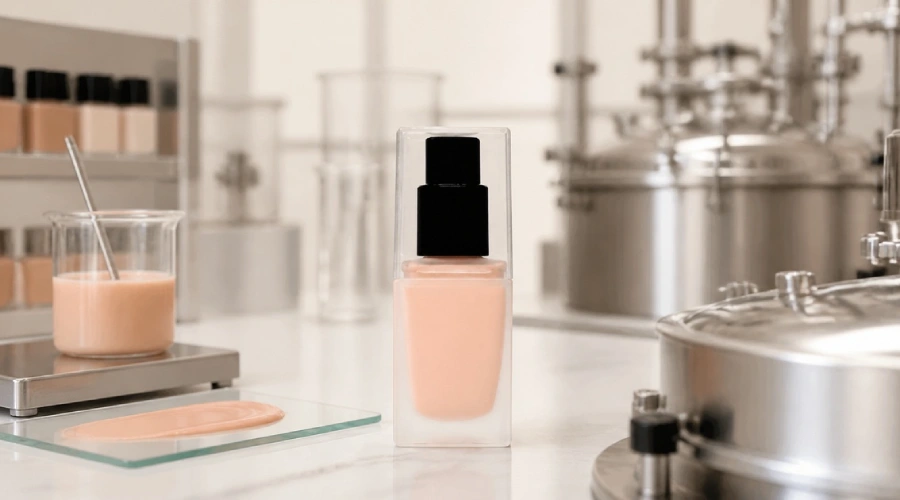
A laboratory sample proves that a cosmetic concept can work at a small scale. It does not automatically prove that the same formula will behave identically in commercial equipment, fill consistently into the selected package, or remain within agreed specifications across a full production batch.
For beauty brands, formula scale-up is the controlled transfer of a product and its manufacturing process from the laboratory to larger equipment. The objective is not simply to multiply every ingredient by a larger number. It is to preserve the attributes that matter while the batch size, mixing conditions, heat transfer, handling time, filling process, and packaging environment change.
Why a larger batch can behave differently
Production equipment changes the physical conditions around a formula. A larger vessel may heat and cool differently from a laboratory beaker. Mixing energy may not reach every part of the batch in the same way. The order and speed of addition, holding time, transfer method, and point at which pigments or temperature-sensitive materials are introduced may all influence the result.
This matters across color cosmetics. A liquid foundation may show changes in viscosity or pigment distribution. A lipstick bulk may respond differently to heating and cooling. A powder product may be sensitive to blending, binder distribution, compaction, and the interaction between the formula, pan, and pressing process.
The practical lesson is simple: an approved laboratory sample should be paired with an agreed process and acceptance criteria. Appearance alone is not enough.
What should be fixed before scale-up begins?
A brand and manufacturer should separate decisions that are already approved from decisions that remain open. Before a trial or pilot batch, confirm the following:
- the correct formula and sample version;
- the intended shade, finish, texture, payoff, and application experience;
- the selected primary package, applicator, pan, or component set;
- the target market and any claim or labeling constraints that affect development;
- the attributes that will be checked during and after production;
- who has authority to accept a result or request a revision;
- which differences are acceptable and which require investigation.
If these points are not documented, the production team may be asked to reproduce a sample without a shared definition of what “matching” means.
Build acceptance criteria around observable product attributes
Useful acceptance criteria connect the product brief to observations or measurements that can be reviewed consistently. The exact list depends on the formula and market, but a color-cosmetics project may consider:
| Area | Questions to define before production |
|---|---|
| Appearance | What is the approved shade, finish, surface, fill appearance, and component presentation? |
| Use characteristics | Which texture, pickup, spread, payoff, glide, or application attributes matter to the product concept? |
| Physical properties | Which formula-specific properties require checking, and what agreed range or comparison method applies? |
| Package interaction | Does the bulk fill, dispense, close, and remain presentable in the selected component? |
| Documentation | Which approved reference, specification, artwork version, and batch records identify the intended result? |
The U.S. FDA’s cosmetics GMP guidance describes written formulations and processing instructions, in-process or finished-product sampling, acceptance specifications, batch identification, and production records as important manufacturing controls. These principles help explain why a scale-up decision should be documented rather than based on memory or an informal visual comparison.
What happens during a trial or pilot batch?
The terminology varies between manufacturers, but the purpose is generally to learn whether the proposed production process can reproduce the intended product at a larger scale. A useful trial records what was done, what was observed, and what needs to change before routine production.
Questions for the brand to discuss include:
- Which process variables are considered important for this formula?
- Where will samples be taken during or after the batch?
- Which reference and specifications will be used for comparison?
- How will a deviation be documented and evaluated?
- Will packaging and filling be assessed with the actual production components?
- What evidence is needed before the project can proceed to commercial production?
A trial batch should not be treated as a ceremonial step. It is a decision point: proceed, adjust the process, revise the specification, repeat the trial, or return to development.
Scale-up, stability, and packaging answer different questions
These activities are related but not interchangeable. Scale-up asks whether the product and process can be transferred to larger equipment. Stability work evaluates how the product behaves under defined conditions over time. Packaging compatibility focuses on interactions and function within the selected package. A successful scale-up does not replace the other evidence a project may require.
Brands should therefore map the full approval path rather than rely on one “passed sample.” The correct path depends on the product, packaging system, intended markets, risk profile, and the responsibilities agreed with qualified technical and regulatory parties.
How brands can reduce avoidable scale-up problems
- Control versions. Identify the exact formula, shade, packaging, artwork, and sample being approved.
- Write the important attributes down. Avoid vague instructions such as “make it smoother” or “match the first sample” without a shared comparison method.
- Limit simultaneous changes. If formula, shade, component, and process all change together, it becomes harder to understand the cause of a difference.
- Use the intended component. Filling and application behavior can depend on the final pan, bottle, tube, compact, closure, or applicator.
- Define the decision owner. Record who can approve the outcome and how feedback will be consolidated.
- Preserve the record. Keep the approved reference and written decision accessible for repeat orders.
Questions to send with a scale-up inquiry
When discussing a project with a color-cosmetics manufacturer, provide the product format, approved sample version, target market, shade and finish direction, selected packaging, expected order scope, critical product attributes, and unresolved questions. You can review the broader private-label business process and the existing guide to cosmetic sampling before preparing the handoff.
If your project is ready for a feasibility discussion, contact AKIACO with the current formula route, product format, packaging direction, approved reference, and intended market. The goal of the first discussion is to identify what is fixed, what remains open, and what evidence is needed before commercial production.