
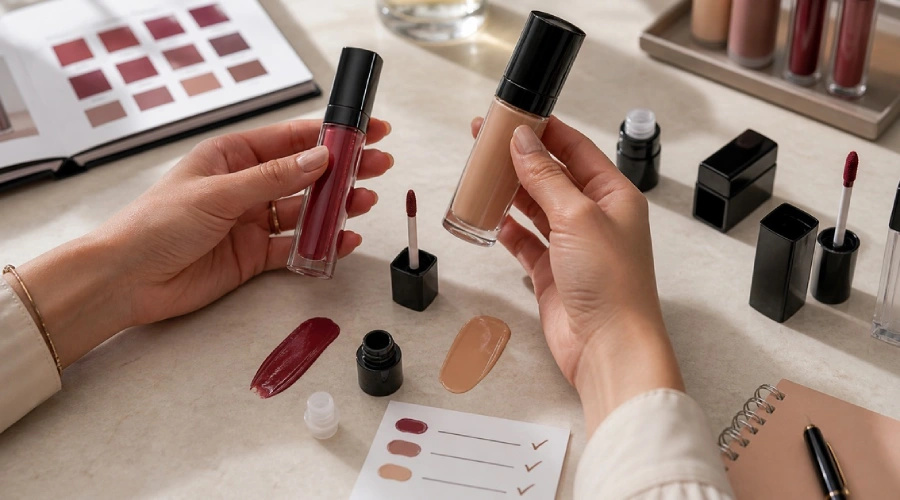
A cosmetic package can look correct when empty and still be unsuitable once it contains the final formula. A wiper may deliver too much lip color. A closure may leak after storage. A compact may not protect a pressed pan during handling. A decoration may soften where the product repeatedly touches it. The formula can also change in color, odor, texture, weight, or performance while the package appears unchanged.
Packaging compatibility testing examines the formula and its complete packaging system together. For beauty brands, the purpose is not to prove that one material is universally “safe” or “best.” It is to determine whether the selected formula, container, closure, applicator, decoration, and use pattern remain acceptable under conditions relevant to the actual product.
This guide explains what compatibility testing should help a buyer verify, how to prepare representative samples, what to inspect, and what must be documented before packaging approval.
What is cosmetic packaging compatibility testing?
Cosmetic packaging compatibility testing evaluates whether a finished or technically representative formula and its intended package can work together over time. The assessment looks in both directions:
- The formula may affect the package: contact can change a container, liner, gasket, wiper, coating, adhesive, ink, metal component, or applicator.
- The package may affect the formula: the package may fail to protect it, absorb part of it, release substances, or alter its appearance, odor, texture, or other relevant characteristics.
- The assembled system may stop working as intended: leakage, seal loss, poor dispensing, difficult opening, component movement, excessive residue, or damage during normal handling may appear even when individual parts looked acceptable.
Compatibility is therefore not a test of the bottle alone. Depending on the format, the system may include a compact, pan, jar, bottle, tube, stick mechanism, cap, pump, valve, dip tube, liner, seal, gasket, wiper, wand, brush, sponge, sifter, adhesive, coating, printing, and secondary pack.
Compatibility testing is related to stability—but it is not the same decision
| Assessment | Primary question | Typical focus |
|---|---|---|
| Formula stability | Does the formula remain within its defined quality and safety requirements? | Appearance, odor, texture, pH or viscosity where relevant, separation, color, and other product-specific specifications |
| Packaging compatibility | Do the formula and complete package remain suitable together? | Interaction, protection, leakage, sealing, dispensing, component integrity, decoration, and product changes linked to the package |
| Distribution testing | Can the packed product withstand relevant shipping and handling hazards? | Impact, vibration, compression, orientation, closure movement, scuffing, breakage, and secondary-pack protection |
| Consumer-use evaluation | Does the pack function through realistic opening, closing, application, and storage? | Priming, dosing, wiping, pickup, residue, hygiene exposure, repeated use, and usability |
These workstreams can overlap, but one result should not be treated as proof of all the others. A formula may remain stable in an inert laboratory container but change in the commercial pack. A package may remain leak-free in storage but perform poorly when its applicator is used repeatedly. A filled component may pass compatibility observations but still need separate distribution evaluation.
For the adjacent formula-focused role, see the guide to stability testing in cosmetics. This article remains focused on the formula–package system and the buyer’s packaging approval decision.
Start by mapping the complete packaging system
Before samples are filled, list every component and surface that may contact the product directly or indirectly. Direct contact is obvious, but headspace, vapor, wicking, spills around the neck, repeated wiping, and product transferred by an applicator can expose additional materials.
A useful component map records:
- the primary container, pan, tube, bottle, jar, compact, or stick body;
- the resin, glass, metal, coating, or other material specification where known;
- closures, liners, seals, gaskets, valves, springs, pistons, dip tubes, and wipers;
- wands, brushes, puffs, sponges, tips, and other applicators;
- printing, lacquers, metallization, hot stamping, labels, and adhesives;
- fill quantity, headspace, closure setting, and assembly configuration;
- secondary cartons, inserts, and protective elements relevant to transport or storage.
What this means for your project: “PET bottle with pump” is not a complete test identity. The resin grade, color, decoration, pump engine, gasket, spring, dip tube, closure fit, supplier, and production revision may all matter. Record the exact approved configuration so a result is not mistakenly applied to a different component later.
Use the final formula and production-representative packaging
Compatibility evidence is strongest when the test article represents the intended commercial product. A formula base without its final color, fragrance, solvent level, preservative system, or other relevant material may behave differently. An undecorated sample may not answer questions about the production coating, ink, adhesive, or metallized finish.
Early screening can still be useful. Brands may compare candidate components before every detail is locked. The important point is to label the evidence correctly:
- Screening sample: helps identify obvious risks or narrow options; not final approval.
- Technically representative sample: close enough to answer defined questions, with differences documented.
- Production-representative sample: matches the intended formula, materials, decoration, assembly, fill, and component specifications as closely as practical.
If any tested element changes, assess whether the previous evidence still applies. A new supplier, resin grade, recycled-content level, pigment, coating, wiper, gasket, applicator, formula ingredient, fill condition, or assembly method can introduce a new question.
What should a compatibility plan define?
There is no single universal temperature, duration, orientation, checkpoint, or pass/fail rule for every cosmetic formula and package. ISO’s stability-testing guidance explicitly leaves protocols, specifications, methods, and conditions to be defined and justified for the product. The plan should reflect the formula, package, intended shelf life, storage, distribution, use, target markets, and known risks.
Before testing begins, document:
- Test objective: the exact compatibility questions being answered.
- Sample identity: formula batch, shade, component specifications, supplier, decoration, assembly, and fill details.
- Controls or comparisons: retained formula or alternative component where appropriate.
- Conditions: justified storage, orientation, light, temperature, humidity, handling, or use exposures.
- Checkpoints: when observations and measurements will be made.
- Methods: how leakage, appearance, function, weight, dimensions, formula properties, or other criteria will be assessed.
- Acceptance criteria: what is acceptable, unacceptable, or requires investigation.
- Responsibilities: who inspects, records, reviews, investigates, and approves.
A vague instruction such as “check whether the package is good” produces weak evidence. A controlled plan makes results comparable and links approval to the correct formula and component version.
What should beauty brands inspect?
1. Leakage and seal integrity
Look for visible leakage, seepage around threads or seals, wetness inside the cap, product movement into unintended areas, and changes after orientation or handling. Slow leakage can be missed when a sample is kept upright and inspected only once.
The package should also be checked after opening and reclosing. A system that seals correctly when new may behave differently after product has reached the threads, wiper, liner, or closure surfaces.
2. Material and component changes
Inspect for swelling, softening, brittleness, cracking, stress marks, deformation, corrosion, discoloration, delamination, loss of adhesion, or changes in fit. Include hidden components where practical: gaskets, liners, springs, wipers, valve parts, and internal coatings can affect function before the outer package shows a problem.
3. Formula changes inside the pack
Compare relevant properties against the approved starting point and suitable controls. Depending on the formula, this may include color, odor, appearance, clarity, texture, separation, sedimentation, crystallization, viscosity, pH, weight, or other specifications.
A visible change does not identify its cause by itself. Formula instability, package interaction, light exposure, oxygen or moisture transmission, evaporation, contamination, and handling can produce overlapping symptoms. Unexpected findings should be investigated rather than assigned to the package automatically.
4. Dispensing and application
The commercial package must deliver the product as intended. Check the complete use sequence:
- opening and closing;
- pump priming and repeat dispensing;
- wiper loading and removal of excess product;
- wand, brush, sponge, or tip performance;
- stick extension and retraction;
- sifter or screen flow;
- powder pickup from the pan;
- residue, clogging, drying, or product trapped in the package.
“It dispenses” is not always a useful acceptance criterion. Define what normal application should look like for the product and selected tool.
5. Decoration and retail appearance
Formula contact, oils from handling, humidity, light, friction, and cleaning can affect labels, ink, foil, lacquer, soft-touch coating, adhesive, or metallization. Check the areas most likely to be touched or exposed during filling and use, including the neck, cap, hinge, applicator opening, and surfaces next to a product swatch.
A decoration issue may not change the formula, but it can still make the commercial pack unacceptable. Define visual tolerances before review instead of deciding after samples have changed.
Color-cosmetics compatibility questions by format
Different formats place different demands on the package. The following are buyer prompts, not universal failure predictions.
Pressed powders and palettes
- Does the pan fit and remain supported in the compact or palette?
- Does the adhesive or retention method remain secure?
- Can the product be picked up with the intended brush, puff, or finger without the package obstructing use?
- Does the closure protect the pan from normal handling?
- Do mirror, insert, hinge, magnet, decoration, and secondary packaging remain acceptable?
Breakage risk is not a formula-only or package-only question. Pan dimensions, fill, compaction, adhesive, compact support, empty space, applicator storage, and distribution conditions can interact.
Lipstick and other stick formats
- Does the mechanism extend and retract the bullet without scraping or loosening it?
- Does the formula maintain suitable clearance from the cap and cup?
- Do heat exposure and normal handling affect the bullet, cup, mechanism, or closure?
- Do internal surfaces, decoration, and cap fit remain acceptable after repeated use?
Lip gloss, liquid lip, and wand-applied eye products
- Does the wiper match the formula viscosity and applicator?
- Is product loading consistent enough for the intended application?
- Do the rod, tip, wiper, neck, cap, and seal remain functional after contact and repeated use?
- Are leakage, drying around the neck, component swelling, and excess residue controlled?
Liquid or cream complexion products
- Can the pump, airless system, tube, jar, or bottle dispense the intended texture?
- Does the package protect the formula from relevant light, air, moisture, or repeated consumer contact?
- Are priming, dose consistency, closure, residue, and product recovery acceptable?
- Does the formula remain uniform through the intended use pattern?
These questions should be translated into product-specific methods and acceptance criteria. Avoid approving a component because it worked for a different formula with the same category name.
How to review a compatibility result
At each checkpoint, record the sample identity, condition, orientation, observations, measurements, photographs, and reviewer. Compare with the starting specification and any control. If a result is outside the planned criteria, document the finding before changing the formula or package.
A failure does not automatically identify the corrective action. Possible paths include:
- changing a component material, grade, coating, liner, wiper, gasket, or applicator;
- adjusting fit, dimensions, filling, headspace, assembly, or closure settings;
- changing the formula where technically and commercially appropriate;
- revising decoration or label construction;
- adding secondary protection;
- repeating a controlled test to confirm the cause and corrective action.
Do not keep only the final “pass” email. Retain the protocol, formula and package identities, raw observations, deviations, investigation, decision, approvers, and any limitations. The evidence must remain traceable to the configuration that will be produced.
Packaging compatibility and market responsibilities
Compatibility testing should be planned with the intended markets in mind, but it is not a universal compliance certificate. In the United States, companies marketing cosmetics are responsible for product safety, and packaging that does not adequately protect a product can contribute to contamination risk. The appropriate safety support depends on the product.
For the European Union, the cosmetic product safety report includes the product’s stability under reasonably foreseeable storage conditions and relevant packaging-material characteristics, particularly purity and stability. EU guidance also recognizes that substances may migrate from packaging or that the product may deteriorate through contact with it.
These requirements do not create one global compatibility protocol. Brands should confirm the current safety, documentation, testing, labeling, and responsible-person requirements for each destination market with qualified regulatory and safety professionals.
When should packaging compatibility be revisited?
Review whether new compatibility work is needed when a change could affect the formula–package system. Examples include:
- a formula, fragrance, color, preservative, solvent, or other relevant ingredient change;
- a new packaging supplier, material grade, colorant, recycled-content level, coating, or decoration;
- a change to the closure, liner, gasket, wiper, valve, spring, applicator, pan, or adhesive;
- a tooling, dimension, fill, assembly, or process change;
- a new sales market, storage condition, distribution route, or consumer-use pattern;
- a complaint or production finding that suggests interaction or functional failure.
The decision should be risk-based and documented. Not every minor change requires the same scope, but a previous result should not be transferred automatically to a materially different configuration.
A buyer checklist before approving cosmetic packaging
- Is the tested formula the final or clearly identified representative version?
- Are all product-contact and function-critical components identified?
- Does the tested decoration and assembly represent production?
- Are storage, orientation, handling, use, and distribution conditions justified?
- Were acceptance criteria defined before results were reviewed?
- Were formula appearance, package integrity, sealing, dispensing, and decoration assessed where relevant?
- Are unexpected results investigated rather than explained by assumption?
- Is the approved result traceable to the formula, shade, package specification, supplier, and version?
- Are separate stability, microbiological, transport, safety, and regulatory questions still addressed?
- Will changes trigger a documented review of whether retesting is needed?
Packaging should be approved as part of the finished product—not only as a visual component or a purchasing line item. The cosmetic sampling process provides the broader product-approval context, while the sustainable packaging guide covers environmental positioning and sourcing questions that remain separate from compatibility evidence.
Discuss formula and packaging requirements
Before requesting packaging options, prepare the product format, final or representative formula direction, target markets, intended package and applicator, decoration, storage and distribution expectations, and approval criteria. Review AKIACO’s private-label development process, then use the contact page to discuss the actual project. Component availability, development route, testing responsibilities, documents, commercial terms, and timing should be confirmed for that scope.
Frequently asked questions
Is packaging compatibility testing the same as stability testing?
No. Stability testing focuses on whether the formula remains within defined requirements over time and under relevant conditions. Packaging compatibility focuses on whether the formula and complete package remain suitable together. The studies can be coordinated, but one should not automatically be treated as proof of the other.
Can an empty package be approved for formula compatibility?
An empty component can be inspected for dimensions, appearance, basic assembly, and some mechanical functions, but it cannot show how the actual formula and package will interact. Formula compatibility requires a defined filled-product evaluation.
Does glass packaging eliminate compatibility risk?
No material should be approved by reputation alone. Even when the main container is relatively inert for a particular formula, closures, liners, pumps, gaskets, coatings, decoration, headspace, light exposure, breakage, and dispensing still require product-specific review.
Is there a standard compatibility test duration for every cosmetic?
No single duration or condition is suitable for every formula and package. The protocol should be defined and justified for the product, intended shelf life, storage, distribution, use, markets, and identified risks.
Does a compatibility pass prove the product is safe and compliant?
No. Compatibility evidence answers defined formula–package questions. Product safety, microbiological quality, stability, claims, labeling, transport, manufacturing controls, and market-specific compliance require their own appropriate evidence and review.