
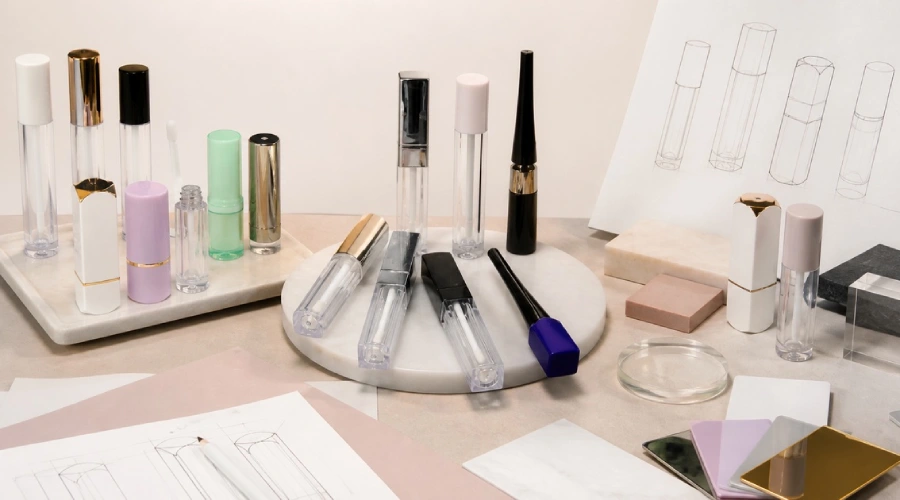
Cosmetic packaging is rarely a simple choice between “generic” and “fully custom.” A beauty brand may select an existing component, customize the surface of a stock structure, develop a new secondary carton, or invest in a proprietary primary-package mold. These routes create different development work, risks, and coordination requirements.
For color cosmetics, the right packaging route should fit the formula, applicator, product architecture, brand differentiation, expected order scope, target launch window, and evidence required before production. The most expensive-looking option is not automatically the best one.
Three packaging routes
1. Stock packaging
Stock packaging uses an existing component structure that is already available from a packaging supplier. The bottle, tube, compact, pan system, closure, or applicator may still offer choices in color, finish, or decoration, but the underlying structure already exists.
This route can reduce structural development work and allows a brand to evaluate a known component family. Its limitations may include less exclusivity, fixed dimensions, fixed applicator choices, and dependence on current supplier availability.
2. Semi-custom packaging
Semi-custom packaging starts with an existing structure and adds brand-specific treatments. Depending on the component, these may include color, printing, labeling, decoration, finish, or an outer carton designed around the stock primary package.
This route can create a more distinctive presentation without changing every structural element. However, “semi-custom” is not a universal technical category. Ask the supplier to identify exactly which parts are stock and which parts will be changed.
3. Custom-mold packaging
Custom molding changes the structure itself. A brand may develop a unique shape, capacity, mechanism, component relationship, or other structural feature. This introduces tooling, engineering, samples, approvals, and ongoing control questions that do not apply in the same way to a standard component.
A custom mold can support structural differentiation, but it also creates more decisions. Tooling responsibility, ownership, storage, maintenance, modifications, component tolerances, replacement, and repeat-order continuity should be addressed in writing.
Compare the routes by project risk
| Decision area | Stock | Semi-custom | Custom mold |
|---|---|---|---|
| Structure | Existing | Existing structure with selected customization | New or materially changed structure |
| Brand differentiation | Primarily selection and artwork | Surface, color, decoration, and secondary pack | Structure plus decoration |
| Development work | Selection and validation | Selection, artwork, decoration, and validation | Engineering, tooling, sampling, validation, and control |
| Supply questions | Availability and continuity | Base-component supply plus decoration capacity | Tooling control, production capacity, maintenance, and continuity |
| Best used when | An existing structure fits the product and brand | The structure works but the presentation needs more identity | The product or positioning requires a distinct structural solution |
This table is a decision framework, not a promise about cost, minimum order quantity, or lead time. Those terms depend on the component, material, supplier, decoration, tooling, order, and commercial agreement.
Start with formula and application requirements
Packaging must do more than look appropriate. It needs to contain, protect, dispense, present, and support use of the formula. For a color-cosmetics project, ask:
- Does the product require a pan, pot, stick mechanism, tube, bottle, or another format?
- How should the user pick up, dispense, or apply the product?
- Which component surfaces contact the formula?
- Does the package need to support several shades, pans, or component combinations?
- Which fill, assembly, decoration, and transit conditions need evaluation?
- What evidence is required before the complete package is approved?
A visual mock-up cannot answer every functional question. Evaluate the final formula and complete packaging system through the appropriate project-specific checks.
Do not confuse primary and secondary packaging
Primary packaging directly contains or contacts the product, such as a lipstick mechanism, lip-gloss tube, compact, pan, bottle, or closure system. Secondary packaging—often a carton—surrounds the finished primary pack.
A brand can use a stock primary component with a custom secondary carton. It can also use a stock structure with custom surface decoration. Therefore, “custom packaging” should always be unpacked into specific layers and components before comparing quotations or approving a design.
Questions to ask before choosing a custom mold
- Which exact component or structure requires a new mold?
- What product or user requirement cannot be met by an existing component?
- Who pays for, owns, stores, maintains, and can use the tooling?
- How are drawings, prototypes, and pre-production samples approved?
- How will formula contact, function, decoration, assembly, and transit be evaluated?
- What happens if the component needs modification?
- How will repeat orders and replacement tooling be handled?
- Which intellectual-property questions require independent legal review?
AKIACO’s project context confirms that packaging is primarily externally sourced and that custom mold development is available, with the customer responsible for mold cost. Exact mold cost and lead time are not universal and must be confirmed for the specific project.
When stock packaging is the stronger decision
Stock packaging may be the better route when an existing structure fits the formula and applicator, the brand can create enough identity through color and decoration, structural exclusivity is not essential, or the team wants to reduce the number of new engineering decisions.
That does not make the project “generic.” A coherent product can still be built through formula, shade, finish, component selection, decoration, artwork, and secondary packaging. The decision should be judged against the intended customer, channel, assortment, and commercial plan.
When custom molding deserves consideration
Custom molding may be justified when a distinct structure supports a real product or brand requirement that stock options cannot meet. The case is stronger when the team can define the requirement, approve engineering stages, support the tooling program, and manage the implications for validation and repeat supply.
Avoid using a custom mold only because it sounds more premium. Structural novelty should have a clear purpose.
Create a packaging-route brief
Before requesting options, document the product format, formula status, application method, target market, component type, required dimensions or capacity, decoration direction, secondary packaging, expected order scope, launch constraints, reference examples, and open technical questions.
Review the broader private-label business process to understand where packaging decisions fit. If samples are already being developed, use the guide to cosmetic sampling to organize the next review.
To discuss stock, decorated, or custom-mold options for an adult color-cosmetics project, contact AKIACO with the product format, formula stage, preferred component type, reference images, decoration direction, target market, and expected order scope.