
Quick Answer
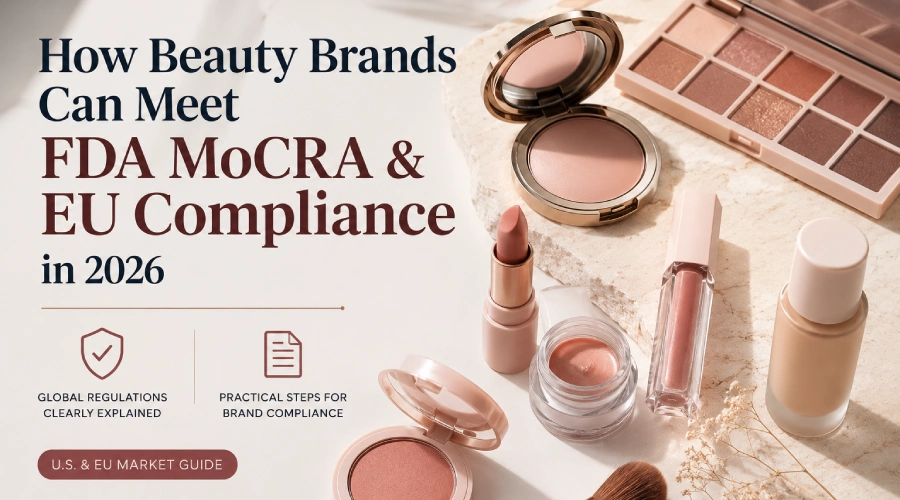
To meet FDA MoCRA and EU cosmetic compliance requirements in 2026, beauty brands need to focus on five operational areas:
- Facility registration and product listing
- Product safety substantiation and documentation
- Ingredient and labeling compliance
- Adverse event reporting and traceability
- Responsible manufacturing and quality control systems
For most beauty brands, compliance is no longer just a legal issue. It directly affects Amazon approvals, retailer onboarding, customs clearance, insurance eligibility, and long-term brand credibility.
The most efficient approach is to build compliance into product development and manufacturing from the beginning rather than fixing issues after launch.
Why Cosmetic Compliance Matters More in 2026
The global cosmetics industry is moving toward stricter transparency, safety validation, and supply chain accountability.
In the United States, the FDA Modernization of Cosmetics Regulation Act (MoCRA) significantly expanded FDA oversight over cosmetic products and facilities.
In the European Union, Regulation (EC) No 1223/2009 continues to enforce some of the world’s strictest cosmetic safety and documentation standards.
In practice, this means:
- Retailers are asking for more compliance documentation before onboarding brands
- Importers and distributors are conducting stricter supplier audits
- Product claims are receiving more regulatory scrutiny
- Incomplete technical documentation can delay product launches
- Non-compliant labeling may lead to customs holds or product removal
For startups and growing beauty brands, compliance is now part of market entry strategy.
FDA MoCRA Compliance Requirements for Beauty Brands
What Is MoCRA?
MoCRA is the biggest update to U.S. cosmetic regulation in decades.
It gives the FDA expanded authority over:
- Cosmetic facility registration
- Product listing
- Safety substantiation
- Serious adverse event reporting
- Record access
- Mandatory recalls under certain conditions
Beauty brands selling products in the U.S. should treat MoCRA compliance as a baseline operational requirement.
1. Facility Registration
Under MoCRA, cosmetic manufacturing facilities generally must register with the FDA.
This requirement applies to facilities involved in manufacturing or processing cosmetic products distributed in the U.S.
Key operational logic
If your manufacturer is not properly prepared for FDA registration requirements, your brand may face:
- Delayed market entry
- Retail compliance issues
- Increased legal exposure
- Supply chain disruption during FDA inspections
Best practice
Work with manufacturers that already support:
- GMP-oriented production systems
- Batch traceability
- Production documentation
- Regulatory cooperation
Brands should confirm whether their OEM or private label manufacturer has experience supporting U.S.-bound products.
2. Product Listing
MoCRA also requires cosmetic product listing submissions.
Brands should maintain:
- Accurate product names
- Ingredient lists
- Manufacturing information
- Responsible person information
Common mistake
Many startup brands assume compliance ends after product formulation.
In reality, incomplete administrative documentation is one of the most common operational weaknesses in emerging beauty brands.
3. Safety Substantiation
Every cosmetic product marketed in the U.S. must have adequate safety substantiation.
This means brands should maintain evidence showing that a product is safe under labeled or customary conditions of use.
What brands typically need
Depending on product type, documentation may include:
- Ingredient safety reviews
- Stability testing
- Microbiological testing
- Compatibility testing
- Challenge testing
- Toxicological assessments
Decision framework
The higher the product risk profile, the stronger the supporting documentation should be.
Examples:
Brands entering major retailers should prepare documentation beyond minimum legal thresholds.
4. Adverse Event Reporting
MoCRA requires responsible persons to report serious adverse events.
Brands should establish:
- Customer complaint systems
- Batch tracking systems
- Documentation retention procedures
- Internal escalation workflows
Operational reality
The speed of traceability matters.
If a brand cannot quickly identify:
- affected batches,
- production dates,
- ingredient records,
- or manufacturing history,
regulatory risk increases significantly.
This is why manufacturing systems matter as much as formulation quality.
5. Labeling Compliance
FDA labeling issues remain one of the most common reasons products encounter market problems.
Brands should verify:
- INCI ingredient formatting
- Net contents declarations
- Responsible person information
- Warning statements where applicable
- Claim consistency
Important distinction
Cosmetics cannot make drug claims unless properly regulated as drugs.
Examples of high-risk claims:
- “Treats acne”
- “Heals eczema”
- “Repairs skin disease”
Safer cosmetic-oriented claims usually focus on:
- appearance,
- hydration,
- cleansing,
- brightening,
- or cosmetic benefits.
EU Cosmetic Compliance Requirements in 2026
Compared with the U.S., EU cosmetic regulations are generally more documentation-heavy.
The EU framework prioritizes:
- product safety,
- ingredient restrictions,
- technical documentation,
- and responsible person accountability.
1. Appoint an EU Responsible Person
Non-EU brands must appoint an EU Responsible Person (RP) before placing cosmetic products on the EU market.
The RP is responsible for:
- ensuring product compliance,
- maintaining documentation,
- communicating with authorities,
- and supporting post-market surveillance.
Strategic recommendation
Brands should clarify RP responsibilities early during product development rather than after packaging is finalized.
Late-stage compliance adjustments often create:
- artwork revisions,
- launch delays,
- and unnecessary reformulation costs.
2. Prepare a Product Information File (PIF)
The Product Information File is one of the most important EU compliance requirements.
A compliant PIF typically includes:
- Product description
- Cosmetic Product Safety Report (CPSR)
- Manufacturing method and GMP statement
- Proof of effect for claims
- Data on animal testing
Compliance logic
If documentation cannot support product claims or safety conclusions, the product may face enforcement action even if no consumer injury occurs.
In the EU, documentation quality is part of compliance itself.
3. Cosmetic Product Safety Report (CPSR)
The CPSR is prepared by a qualified safety assessor.
It evaluates:
- ingredient toxicology,
- exposure levels,
- impurities,
- packaging compatibility,
- and overall product safety.
Why this matters operationally
Some trendy ingredients may be acceptable in one market but restricted in another.
For example:
- concentration limits,
- preservative usage,
- fragrance allergens,
- and color additive rules
can differ significantly between the U.S. and EU.
Brands targeting both markets should formulate with dual-market compliance in mind from the beginning.
4. CPNP Notification
Before selling in the EU, cosmetic products must be submitted through the Cosmetic Products Notification Portal (CPNP).
Brands typically need:
- formulation details,
- labeling information,
- packaging images,
- and Responsible Person details.
This process should be completed before commercial distribution.
5. EU Labeling Requirements
EU cosmetic labels require careful review.
Common requirements include:
- Ingredient lists using INCI names
- Nominal content
- Period After Opening (PAO) symbol where applicable
- Country of origin for imported products
- Responsible Person address
- Batch coding
- Precautionary statements
Frequent compliance issue
Brands often create one universal label for all markets.
This can create non-compliance because EU and U.S. labeling expectations are not fully identical.
Localized compliance review is usually the safer approach.
FDA vs EU Cosmetics Compliance: Key Differences
For most startups, reducing operational complexity is more important than trying to manage every compliance task independently.
Manufacturing Considerations That Affect Compliance
Regulatory compliance is heavily influenced by manufacturing systems.
Even strong formulations can become problematic if production control is weak.
Brands should evaluate manufacturers based on:
- batch consistency,
- documentation systems,
- raw material traceability,
- microbiological control,
- and packaging compatibility management.
Questions brands should ask manufacturers
- Can you support U.S. and EU documentation requirements?
- Do you provide stability or compatibility testing support?
- Can you help with compliant labeling reviews?
- Do you maintain batch traceability systems?
- Have you manufactured products for export markets before?
- Can you support low-MOQ production for new product launches?
- How do you manage raw material sourcing and supplier verification?
- What is your process for handling formula updates caused by regulatory changes?
- Can your production capacity scale as the brand grows?
- What quality control procedures are used before shipment?
- Can you support both English and multilingual packaging requirements?
- What is your average lead time for sampling and mass production?
Brands should evaluate manufacturers not only on unit pricing, but also on regulatory readiness and operational stability.
A manufacturer with strong compliance support can help reduce:
- reformulation delays,
- packaging revisions,
- customs clearance issues,
- documentation gaps,
- and retailer onboarding problems.
For beauty brands entering competitive international markets, manufacturing capability and compliance capability are increasingly connected.
Common Compliance Mistakes Beauty Brands Make
1. Treating compliance as a final step
Compliance should begin during formula and packaging development rather than after products are ready for launch.
Late-stage regulatory fixes often increase costs and delay timelines.
2. Using unsupported product claims
Marketing claims should align with available testing and documentation.
Claims that imply medical treatment or drug-like effects may trigger additional regulatory scrutiny.
3. Ignoring regional ingredient restrictions
An ingredient accepted in one market may face restrictions in another.
Brands targeting both the U.S. and EU should review formulations with cross-market compliance in mind.
4. Choosing suppliers based only on price
Low-cost manufacturing without documentation support can create larger long-term operational risks.
In many cases, missing compliance documentation becomes more expensive than production itself.
5. Using generic compliance templates
Compliance files should reflect the actual:
- formulation,
- packaging,
- manufacturing process,
- and finished product specifications.
Generic online templates may not satisfy regulatory or retailer review requirements.
Final Takeaway
In 2026, cosmetic compliance is no longer just a regulatory obligation.
It affects:
- market access,
- retailer approvals,
- consumer trust,
- and international growth potential.
Beauty brands preparing for the U.S. and EU markets should focus on:
- Early compliance planning
- Accurate technical documentation
- Market-specific labeling review
- Reliable manufacturing systems
- Long-term product traceability and quality management
For many brands, the most practical approach is working with manufacturing partners already familiar with export-oriented cosmetic production and international compliance expectations.

About Guangdong AKIA Cosmetic Co., Ltd.
Guangdong AKIA Cosmetic Co., Ltd. is a private label cosmetic manufacturer with more than 40 years of manufacturing experience.
The company operates a 40,000-square-meter production facility in Foshan, China, supporting both startup beauty brands and large-scale cosmetic companies.
AKIA focuses on:
- private label and OEM/ODM cosmetic manufacturing,
- low MOQ production,
- fast lead times,
- and export-oriented manufacturing support.
For brands preparing products for the U.S. and EU markets, working with manufacturers that understand compliance workflows and scalable production systems can help simplify product development and reduce operational risk.
Read More >> White Label Makeup For Small Brands: A Practical, In-Depth Guide
Read More >> Private Label Makeup Products: What New Brands Must Know