
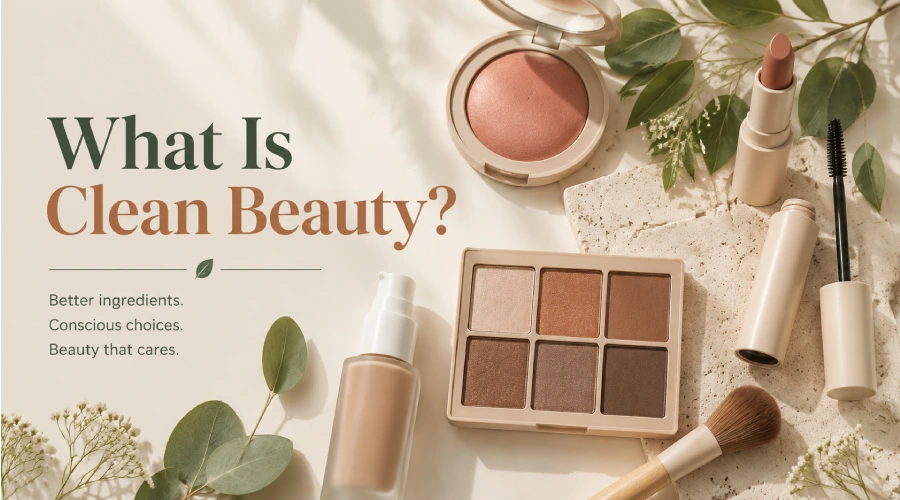
Clean beauty is a term used to describe cosmetic and personal care products that focus on ingredient transparency, responsible formulation, and consumer safety. However, the meaning of “clean” is not fixed because different organizations and consumers may define it in different ways. In general, clean beauty focuses on understanding what ingredients are used, why they are included, and how products are made.
The Basic Definition of Clean Beauty
Clean beauty refers to beauty products that are developed with careful ingredient choices and clear information about formulation. The main idea is not simply about using “natural” ingredients, but about creating products that consumers can understand and make informed choices about.
A clean beauty approach usually focuses on three key areas: ingredient transparency, safety evaluation, and responsible product development. This means brands and manufacturers should provide clear ingredient lists and avoid making claims that are not supported by scientific evidence.
It is important to understand that “clean beauty” is not an official scientific or regulatory term. Unlike terms such as “drug” or “cosmetic” in regulated markets, clean beauty does not have one universal legal definition. Therefore, consumers should look beyond the label and learn how ingredients are selected and tested.
How Clean Beauty Differs From Conventional Beauty Categories
The main difference between clean beauty and conventional beauty categories is often the focus on ingredient standards and communication. Traditional cosmetic products may use a wide range of approved ingredients based on safety tests, performance needs, and product stability.
Clean beauty products usually place more attention on ingredient selection and avoiding certain ingredients that some consumers prefer not to use. These choices may relate to concerns about skin sensitivity, environmental impact, or long-term ingredient use.
However, clean beauty does not mean that conventional cosmetics are unsafe. Cosmetic ingredients used in regulated markets must meet safety requirements before they can be sold. The difference is mainly about formulation philosophy, transparency, and consumer expectations.
For example, a cosmetic scientist may choose an ingredient because it improves product texture, stability, or shelf life. A clean beauty approach may review the same ingredient from a broader perspective, including its source, safety profile, and consumer preferences.
Why the Term “Clean Beauty” Became Popular
The clean beauty movement became popular as consumers started asking more questions about cosmetic ingredients. With easier access to online information, people began paying more attention to product labels, ingredient lists, and scientific research behind skincare and cosmetics.
At the same time, the beauty industry began to respond to a growing demand for clearer communication. Today, many consumers want to understand not only what a product does, but also how it is made and why certain ingredients are included.
The Growing Consumer Focus on Ingredient Transparency and Safety
Ingredient transparency means providing clear and accurate information about a product’s formula. In cosmetics, this usually includes listing ingredients according to international labeling rules, such as the International Nomenclature of Cosmetic Ingredients (INCI) system.
Consumers often check ingredient lists to identify ingredients they may want to avoid or ingredients that match their personal needs. For example, people with sensitive skin may pay closer attention to fragrance ingredients, preservatives, or potential allergens.
However, reading an ingredient list requires basic knowledge. A long ingredient name does not automatically mean an ingredient is harmful, and a natural ingredient is not always safer. Safety depends on factors such as concentration, usage level, formulation method, and scientific evaluation.
Because of this, modern clean beauty discussions are moving toward a more balanced approach. Instead of focusing only on whether an ingredient is “clean” or “not clean,” many experts encourage consumers to consider evidence, product quality, and individual skin needs.
The Core Principles of Clean Beauty
Clean beauty is built around several key ideas that influence how cosmetic products are developed, evaluated, and communicated. While there is no single global standard for clean beauty, most discussions focus on three main areas: clear ingredient information, safety-focused formulation, and responsible practices. These principles help consumers better understand products and make choices based on facts rather than unclear claims.
Ingredient Transparency and Clear Product Information
Ingredient transparency means providing accurate and easy-to-understand information about what a cosmetic product contains. In the beauty industry, ingredients are usually listed using the International Nomenclature of Cosmetic Ingredients (INCI) system, which creates a common language for ingredient labeling worldwide.
Clear product information helps consumers understand the purpose of different ingredients. For example, some ingredients help maintain product stability, some improve texture, and others support product performance. Knowing these roles allows consumers to make better decisions based on their skin type, preferences, and personal concerns.
Transparency also requires responsible communication. Cosmetic companies should avoid unclear statements and explain product features based on scientific evidence. A product label should provide useful information instead of creating confusion through vague or exaggerated claims.
Safety-Focused Formulation Approaches
Safety-focused formulation is an important part of clean beauty. Cosmetic scientists must consider how each ingredient works with others and whether the final product is safe for consumers when used as directed.
A cosmetic formula needs to meet several requirements at the same time. It should provide the desired texture and function, remain stable during storage, and protect against problems such as microbial growth. These factors are essential for product quality and consumer safety.
Clean beauty does not mean removing all synthetic ingredients. Many synthetic ingredients have well-established safety records and important roles in cosmetic products. Instead, a safety-focused approach looks at scientific data, ingredient properties, and the needs of the final product.
Balancing Product Performance, Stability, and Ingredient Considerations
Creating a cosmetic product requires careful balance. For example, preservatives are often needed to prevent bacteria and mold growth, especially in water-based products. Without proper preservation, a product may become unsafe during use.
Formulators also consider factors such as pH level, packaging type, ingredient compatibility, and shelf life. A formula that looks simple may still require advanced testing to ensure it performs correctly.
Therefore, clean beauty formulation is not only about selecting certain ingredients. It also involves applying cosmetic science to create products that are effective, stable, and suitable for consumer use.
Environmental and Ethical Considerations in Clean Beauty
Environmental and ethical factors have become increasingly important in clean beauty discussions. Many consumers now consider not only what they apply to their skin but also how products are produced and how they affect the environment.
These considerations may include packaging choices, responsible sourcing of raw materials, manufacturing processes, and waste reduction. However, environmental claims should be supported by clear information and measurable actions rather than simple marketing language.
A more responsible beauty industry requires cooperation between scientists, manufacturers, suppliers, and consumers. Sustainable practices often involve complex decisions because every material and production method has different environmental impacts.
How Sustainability Factors Influence Modern Beauty Practices
Sustainability influences many parts of cosmetic development, from ingredient sourcing to packaging design. For example, companies may study the environmental impact of raw materials, choose more efficient production methods, or reduce unnecessary packaging.
Ingredient sourcing is another important factor. Some natural ingredients require careful management to prevent overuse of plant resources or damage to local ecosystems. Responsible sourcing helps maintain a balance between ingredient demand and environmental protection.
At the same time, sustainability does not replace safety standards. A cosmetic product must still meet quality and safety requirements. Modern clean beauty practices aim to consider both human health and environmental responsibility through a more complete approach.
What Ingredients Are Commonly Avoided in Clean Beauty?
Clean beauty often involves careful ingredient selection, but there is no universal list of ingredients that all clean beauty standards avoid. Different organizations and consumers may have different views based on safety data, environmental concerns, or personal preferences. Therefore, understanding why certain ingredients receive attention is more important than simply labeling ingredients as “good” or “bad.”
When discussing clean beauty ingredients, it is helpful to look at scientific evidence, ingredient purpose, and usage levels. Cosmetic ingredients are evaluated based on safety, and their effects depend on factors such as concentration, formulation, and how they are used.
Understanding the Role of Ingredient Selection
Ingredient selection is a key part of cosmetic formulation. Cosmetic scientists choose ingredients based on many factors, including product function, safety, stability, texture, and consumer needs. Every ingredient in a formula has a specific role.
For example, moisturizers help improve skin feel, emulsifiers help mix oil and water ingredients, and preservatives help protect products from microbial contamination. Removing an ingredient without understanding its function may affect product quality or safety.
Clean beauty discussions often focus on choosing ingredients carefully and explaining their purpose clearly. The goal is usually to create formulas with thoughtful ingredient choices rather than simply reducing the number of ingredients.

Why Certain Ingredients Receive More Attention in Clean Beauty Discussions
Certain ingredients receive more attention because consumers may have questions about their long-term use, environmental impact, or potential skin reactions. Online discussions and increased access to scientific information have also made people more interested in learning about cosmetic formulas.
For example, some consumers prefer to avoid specific ingredients because of personal concerns, such as fragrance sensitivity or environmental preferences. However, an ingredient receiving attention does not always mean it is unsafe. Safety depends on scientific evaluation and the conditions of use.
It is also important to understand that ingredient safety is based on evidence, not popularity. Regulatory agencies and scientific organizations review cosmetic ingredients using available research to determine acceptable use levels.
Common Ingredient Categories Examined by Clean Beauty Standards
Clean beauty standards often pay attention to certain ingredient categories. However, these ingredients are not automatically unsafe. Their effects depend on factors such as ingredient type, concentration, and scientific evaluation.
When evaluating clean beauty ingredients, it is important to look at scientific evidence rather than judging ingredients only by their names or origins. A well-designed formula should balance safety, performance, and consumer needs.
How Clean Beauty Products Are Formulated and Evaluated
Clean beauty products follow many of the same scientific development steps as other cosmetic products. A formula must be carefully designed, tested, and reviewed before reaching consumers. The process focuses on ingredient selection, product safety, stability, and performance.
Although clean beauty often emphasizes transparency and careful ingredient choices, product development still depends on cosmetic science. A successful formula requires a balance between consumer expectations, ingredient functions, and safety requirements.
The Product Development Process Behind Clean Beauty Formulations
Developing a clean beauty formula starts with understanding the purpose of the product. Cosmetic scientists first define the product type, desired texture, target skin needs, and performance goals. Then, they select ingredients based on their functions and safety information.
During formulation, experts consider how different ingredients interact with each other. For example, a moisturizer may need a combination of water-binding ingredients, oils, emulsifiers, and stabilizers to create a balanced formula.

After creating a formula, the product goes through multiple tests. These tests help confirm that the product remains safe, stable, and effective throughout its expected shelf life.
- Ingredient research is the first important step in product development. Scientists review ingredient properties, safety information, compatibility, and possible limitations before adding them to a formula.
- Testing is then used to evaluate product quality. Common tests may include stability testing, microbial testing, packaging compatibility testing, and safety assessments. These tests help identify changes in texture, color, scent, or product performance over time.
- Quality control continues after production begins. Manufacturers check raw materials, production conditions, and finished products to make sure they meet required standards. This process helps maintain consistency between different batches.
The Importance of Scientific Evidence in Clean Beauty
Scientific evidence plays an important role in understanding clean beauty products. Ingredient decisions should be based on reliable research rather than assumptions about whether an ingredient is natural, synthetic, or popular.
A scientific approach helps consumers understand that every ingredient has a purpose. For example, some ingredients improve product stability, while others support texture or skin feel. Evaluating an ingredient requires looking at its function, safety data, and usage level.
Separating Ingredient Facts From Marketing Claims
In the beauty industry, marketing terms can sometimes create confusion. Words such as “clean,” “natural,” or “non-toxic” may have different meanings depending on the company or organization using them.
Consumers should look for clear information, including ingredient lists, product explanations, and evidence-based claims. A product claim should be supported by testing or scientific data rather than only attractive language.
For example, an ingredient being natural does not automatically mean it is safer, and an ingredient being synthetic does not automatically mean it is harmful. The most reliable evaluation considers the complete formula, safety testing, and how the product is designed for use.
Clean Beauty vs. Natural Beauty: What Is the Difference?
Clean beauty and natural beauty are often discussed together, but they focus on different aspects of cosmetic products. Natural beauty mainly looks at ingredient sources, while clean beauty focuses on transparency, safety considerations, and formulation choices.
Learning basic ingredient information can help consumers avoid common misunderstandings. For example, a complex ingredient name does not automatically mean it is unsafe, and a natural ingredient does not automatically guarantee better results.
Evaluating Clean Beauty Claims Responsibly
Clean beauty claims can provide useful information, but they should be viewed carefully. Terms such as “clean,” “natural,” or “free from” may have different meanings because there is no single standard that defines all clean beauty products.
A responsible evaluation looks beyond marketing language and focuses on evidence. Consumers can check whether product claims are specific, clear, and supported by reliable information.
For example, a statement like “contains plant-based ingredients” provides information about ingredient sources, but it does not explain product safety or performance. A complete evaluation requires looking at the whole formula.
Questions Consumers Should Ask Before Choosing a Product
Before choosing a clean beauty product, consumers can ask the following questions:
- Are the ingredients clearly listed? This helps consumers understand what is included in the formula.
- What is the purpose of the key ingredients? Understanding ingredient functions can help explain how the product works.
- Are the product claims supported by scientific evidence? Clear evidence can help separate reliable information from marketing language.
- Does the product match my skin needs? Different skin types may respond differently to the same ingredients.
- Has the product been properly tested for safety and quality? Testing helps ensure that the product is stable and suitable for use.
Choosing a clean beauty product is not about finding a perfect formula. It is about understanding ingredients, checking reliable information, and making decisions based on science rather than assumptions.
Read More >> Non-Comedogenic Makeup Explained
The Benefits and Limitations of Clean Beauty
Clean beauty has changed the way many consumers think about cosmetic products. It encourages people to pay more attention to ingredients, product information, and formulation choices. However, clean beauty also has limitations because the term does not have one universal definition.
A balanced view of clean beauty means understanding both its potential value and its common misunderstandings. Instead of viewing clean beauty as a simple “better” or “safer” category, consumers should consider scientific evidence, product quality, and personal needs.
Potential Benefits of Clean Beauty Approaches
Clean beauty approaches may offer several benefits by encouraging more thoughtful decisions about cosmetic products. However, these benefits depend on responsible formulation and scientific evaluation.
- Increased ingredient awareness: Clean beauty encourages consumers to learn about product ingredients and understand their functions in skincare and cosmetics.
- Greater ingredient transparency: Clear ingredient lists and product information help consumers make choices based on facts rather than unclear claims.
- More responsible formulation practices: Clean beauty discussions often focus on careful ingredient selection, product safety, and environmental considerations.
- Improved consumer understanding: It encourages people to look beyond product labels and consider factors such as formulation quality, testing, and personal skin needs.
Common Misunderstandings About Clean Beauty
Although clean beauty has gained attention, some common ideas about it may not fully match scientific understanding.
- “Clean” always means safer: Product safety depends on ingredient properties, concentration, formulation methods, and scientific testing. Natural ingredients are not always safer, and synthetic ingredients are not always harmful.
- Clean beauty products contain no synthetic ingredients: Some clean beauty formulas may include synthetic ingredients when they are considered suitable for safety, stability, and performance.
- Shorter ingredient lists mean better products: A simple formula is not always more effective. Many products need multiple ingredients to achieve proper texture, stability, and preservation.
- Clean beauty is a guarantee of better results: Product effectiveness depends on the complete formula, ingredient compatibility, and how the product meets individual skin needs.
A scientific approach to clean beauty focuses on transparency, evidence-based decisions, and understanding the complete formulation rather than relying only on labels or assumptions.
The Future of Clean Beauty: Science, Transparency, and Consumer Awareness
Clean beauty is continuing to change as cosmetic science, consumer expectations, and industry standards develop. In the future, clean beauty is likely to move beyond simple ingredient lists and focus more on scientific evidence, product transparency, and responsible development.
As consumers become more informed, they are looking for clearer explanations about ingredients, testing methods, and product performance. This shift is encouraging the beauty industry to combine innovation with better communication.
How Clean Beauty Is Evolving With Cosmetic Science
Modern clean beauty is becoming more connected with cosmetic science. Instead of focusing only on avoiding certain ingredients, many experts are paying more attention to how formulas are designed, tested, and evaluated.
Advances in cosmetic technology allow scientists to create products that balance safety, stability, and performance. New formulation methods can help improve ingredient efficiency, reduce waste, and develop products that meet different consumer needs.
Scientific research also helps provide a clearer understanding of ingredients. As more data becomes available, clean beauty discussions are moving toward evidence-based decisions rather than simple labels such as “natural” or “chemical-free.”

What Consumers Can Expect From Future Beauty Standards
Future beauty standards are likely to place more importance on transparency and scientific support. Consumers may expect brands to provide clearer information about ingredients, sourcing, testing, and environmental impact.
Possible trends in future clean beauty standards include:
- More detailed ingredient information: Consumers may have easier access to explanations about ingredient functions, safety data, and product development.
- Greater focus on scientific evidence: Product claims may need stronger support from research and testing rather than general marketing statements.
- More responsible sustainability practices: Environmental considerations may include packaging, ingredient sourcing, and production methods.
- More personalized beauty solutions: Advances in skin research may help create products that better match individual skin conditions and preferences.
Overall, the future of clean beauty is likely to focus on a balance between transparency, science, and consumer education. The goal is not simply to avoid certain ingredients, but to create a more informed and responsible approach to beauty products.
Read More >> Choosing the Right Texture for Makeup Products