
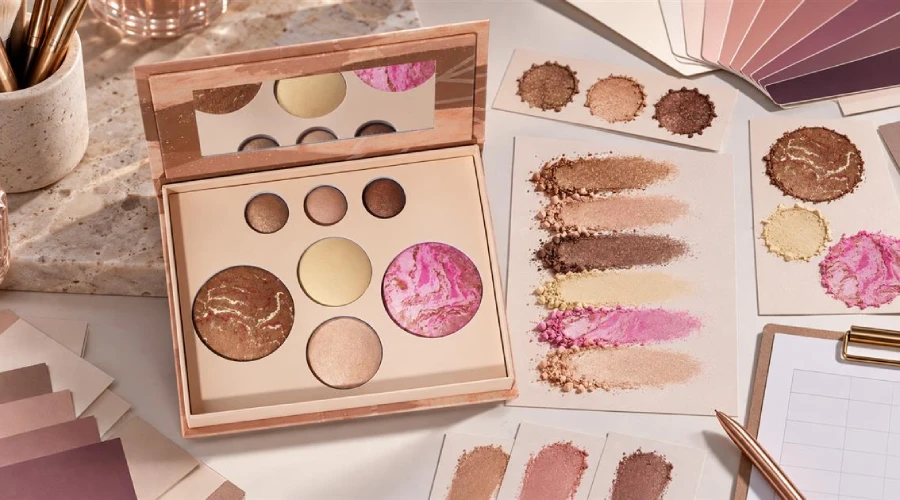
Shade development often slows down when a brand sends a color name, an edited image, or a competitor reference without explaining what must be matched and what can change. “Warm nude,” “true red,” and “rose gold” can describe very different products depending on format, undertone, opacity, finish, application thickness, lighting, and target market.
A manufacturer-ready shade brief turns a visual idea into a reviewable product direction. It also gives the approval team a consistent way to compare samples, consolidate feedback, and identify the exact version that can move to the next stage.
Define the shade’s job in the assortment
Start with the commercial and product role, not only the color name. Explain whether the shade is a core neutral, a seasonal accent, a complexion step, a topper, a deepening shade, a highlight, or part of a coordinated palette. Record the intended product format and finish because the same color direction will not appear identical in a matte pressed powder, reflective eyeshadow, cream blush, lipstick, or translucent gloss.
A useful brief normally includes:
- product category and formula route;
- target customer, market, channel, and assortment role;
- shade family, depth, undertone, saturation, and temperature direction;
- matte, satin, shimmer, metallic, translucent, or other finish direction;
- opacity, coverage, payoff, and buildability expectation;
- application method and intended substrate;
- physical, visual, or numerical references;
- acceptable variation and non-negotiable attributes;
- review conditions, decision owner, and approval record.
Connect these items to the wider color-cosmetics product brief so shade work does not become disconnected from packaging, formula, quantity, market, and launch requirements.
Use references for direction, not as an unexplained instruction
A physical product, color chip, drawdown, swatch, fabric, photograph, or mood board can all help. Each reference has limitations. A competitor product combines color with a specific formula and finish. A printed chip may not reproduce a metallic or pearlescent effect. A phone image changes with camera processing and screen display. A swatch changes with skin tone, application thickness, primer, and lighting.
For every reference, state what matters:
- match the hue direction, not the finish;
- use the reference for depth and undertone;
- keep the reflective effect but reduce the base color;
- use the applied swatch, not the appearance in the pan;
- treat the image as mood only, not a color standard.
This prevents the development team from trying to reproduce every visible attribute of a reference that was never intended as an exact target.
Describe shade and finish separately
Color and finish influence one another but should not be collapsed into one comment. A sample may have the correct hue but too much reflectivity, or the right finish with a base that is too warm. Separate feedback into:
| Review dimension | Example direction |
|---|---|
| Hue and undertone | Move from orange-red toward a cooler blue-red direction. |
| Depth | Keep the undertone but make the applied result slightly deeper. |
| Saturation | Reduce intensity while preserving the same shade family. |
| Opacity or payoff | Maintain color direction but make the first pass less opaque. |
| Finish | Reduce large visible sparkle and move toward a finer sheen. |
| Application | Preserve the pan appearance but improve evenness on the agreed substrate. |
Review the shade in more than one state
Color cosmetics should be reviewed in the states that matter to the product. Depending on format, that can include appearance in the pan or package, pickup on the applicator, a controlled drawdown, a defined number of passes, blended application, and the result under agreed lighting.
Document the substrate and method. Skin, white card, black card, artificial skin, lips, nails, and another base product can produce different visual results. If the product is intended to layer over foundation, primer, or another shade, include that context in the approval plan.
Do not approve from a single phone image alone. Images are valuable for fast communication and records, but automatic exposure, white balance, compression, editing, and screen settings can change the displayed result.
Control viewing conditions and comparisons
Use consistent lighting, background, application method, sample amount, and reference orientation whenever practical. Record the conditions so later reviewers understand what was compared. If instrumental color data is part of the project, document the device, geometry, settings, substrate, and sample preparation rather than sharing an isolated number.
Visual review still matters for effect finishes because sparkle, directional reflection, texture, and application can change with angle. The correct review method depends on the product and the decision being made.
Evaluate a shade range as a system
A collection is more than a group of individually attractive samples. Review the range for spacing, duplication, missing depth or undertone positions, finish balance, and commercial purpose. For a palette, check whether adjacent shades are distinguishable and whether the planned looks or merchandising story are achievable.
For complexion ranges, aesthetic planning and market coverage require project-specific research. Avoid claims that a fixed shade count is automatically inclusive or suitable for every market. For lip, eye, and cheek ranges, consider whether pigments and effect materials also change application, staining, opacity, or physical performance.
Keep aesthetic approval separate from compliance
A brand’s visual approval does not establish that every color additive is permitted for every product area or market. For the United States, the FDA color additives and cosmetics fact sheet explains that color additives must meet applicable identity, specification, use, restriction, and labeling requirements, and that some require batch certification.
Market-specific regulatory review should be handled by qualified parties using the final product, formula, claims, and intended sales markets. Do not use terms such as “FDA approved shade” as a substitute for that work.
Give revision feedback that can be acted on
Collect comments from product, marketing, creative, quality, and management before sending one consolidated response. Identify the sample version and compare it with the named reference under the agreed conditions.
Instead of “make it more premium,” say “keep the base color but replace the larger visible sparkle with a finer reflective finish.” Instead of “the nude is wrong,” say “Sample 3 is deeper and more orange than Reference A in the applied review; move lighter and more neutral while keeping the current opacity.”
Change one decision clearly enough that the next round can be interpreted. If several dimensions must move, list them separately and state which has priority.
Create one controlled approved reference
When the shade is accepted, the approval record should connect:
- project, SKU, and shade code;
- formula and sample version;
- product format, finish, and package;
- physical or documented approved reference;
- review method and relevant conditions;
- approved attributes and any open items;
- approver, decision date, and next authorized step.
Use the makeup sample approval checklist to prevent an approved shade from being confused with a pending formula, package, artwork, or test decision. For repeat orders, agree which retained or documented reference will be used for comparison and what happens when a difference is observed.
Prepare a shade-development inquiry
Send the product format, market, shade architecture, finish and payoff direction, references, application method, package status, order scope, and decision timeline. Mark which attributes are fixed and which are open to manufacturer input.
For powder products, shade decisions should be reviewed with physical pan behavior. The guide to pressed powder formulation and pan performance explains why pigments and effect materials can change pickup, compaction, and surface behavior. When your shade brief is ready, contact AKIACO to discuss the project and sampling route.
Frequently asked questions
What should a makeup shade brief include?
Include product format, target market, shade role, color direction, undertone, depth, finish, opacity, references, application method, and approval method.
Is a reference photo enough for cosmetic shade matching?
No. Photos vary by lighting, camera, screen, and editing, so use them as direction and pair them with controlled physical or numerical references when available.
Should shades be approved only in the package?
Review both package appearance and applied color because substrate, application thickness, finish, and lighting can change the visual result.
Is aesthetic shade approval the same as regulatory approval?
No. Visual approval is separate from confirming that color additives and labeling are suitable for the intended product and market.
What should become the final approved shade reference?
Use one clearly identified physical or documented reference linked to the exact formula, shade, finish, package, review conditions, and approval record.