
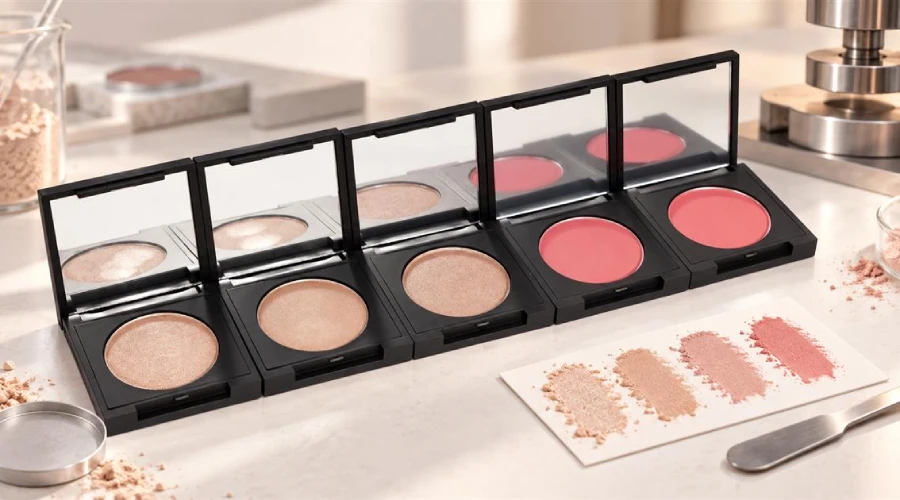
A pressed powder sample can look perfect and still fail in use. It may be too hard to pick up, produce uneven payoff, glaze after repeated contact, create excessive fallout, crack in the pan, or break during handling. These outcomes are rarely controlled by one ingredient or one machine setting. They emerge from the complete system: powder base, pigments and effect materials, binder, mixing and milling, compaction, pan, package, and applicator.
For beauty-brand product developers and sourcing teams, the practical question is not “What is the best pressed powder formula?” It is “Which combination of formula, process, pan, and package produces the performance required for this product?”
Start with the target product, not a generic formula
A matte setting powder, high-shine highlighter, pigmented blush, bronzer, and metallic eyeshadow can all be pressed into pans, but they do not share one performance target. Before comparing samples, define:
- product category and intended use;
- coverage, payoff, finish, and blendability direction;
- application method, such as brush, puff, sponge, or fingertip;
- acceptable fallout and pickup level;
- pan size, depth, shape, and layout;
- compact, palette, closure, and protective features;
- shade range and any special effect materials;
- shipping, retail, and use conditions that matter to the project.
This written target becomes the basis for sampling. If your project requirements are still broad, use a manufacturer-ready color-cosmetics product brief before deciding whether a sample is successful.
What each part of a pressed powder system contributes
Powder base and fillers
The powder phase influences slip, softness, adhesion, oil absorption, optical appearance, flow, and compactability. Changing the balance can improve one property while weakening another. A softer sensory profile may not automatically create a stronger cake, while a highly cohesive powder may not release easily onto the applicator.
Pigments and effect materials
Colorants and reflective materials affect more than shade. Their particle form, surface characteristics, concentration, and distribution can change flow, compression behavior, surface texture, payoff, and breakage. A formula route that works for a matte beige shade may need adjustment for a deep shade or a highly reflective finish.
This is why shade approval and physical pan approval should be connected but recorded separately. The color may be correct while the pickup or cake strength still needs work.
Binder system
The binder helps the powder mass form and retain a coherent cake. It can also influence adhesion, creaminess, pickup, payoff, and the way the surface responds to repeated use. Too little effective binding may leave the product fragile or dusty. Too much, or poor distribution, may contribute to a dense surface and weak pickup.
Brands do not need to prescribe a universal binder percentage. They should describe the desired user experience and evaluate whether the resulting system meets it.
Processing before pressing
Mixing, size reduction, binder addition, sieving, and powder conditioning affect uniformity. Poor distribution can create shade variation, local hardness differences, speckling, inconsistent payoff, or uneven compaction. The sequence and method depend on the formula and process, so a value copied from another product is not a reliable specification.
Compaction and tooling
Compaction gives the powder enough cohesion to remain in a portable pan, but more force is not automatically better. The press setup interacts with fill weight, powder behavior, pan geometry, embossing, pressing cloth, dwell, and other process variables. The useful target is a repeatable cake that balances pickup and durability.
How common pan problems should be interpreted
| Observed problem | Questions to investigate |
|---|---|
| Low pickup | Is the cake too dense for the applicator? Is the surface glazed? Does the binder or finish direction reduce release? |
| Excessive dust or fallout | Is cohesion too low? Is the applicator too aggressive? Does the shade or effect-material load need a different balance? |
| Cracking or edge separation | Are fill distribution, pan shape, pressing, binder distribution, package support, or handling conditions contributing? |
| Pan drop-out | Is the cake adhering to or mechanically retained by the pan as intended? Is the pan/component system suitable? |
| Glazing or hard pan | Does repeated contact compact or contaminate the surface? Are application method and formula surface behavior aligned? |
| Shade-to-shade inconsistency | Do pigment and effect-material differences require separate processing or pressing evaluation? |
This table is a diagnostic starting point, not a formula prescription. The same visible defect can have more than one cause, and changing one variable may alter several performance attributes.
The pan and compact are part of performance
A powder cake should not be evaluated independently from its intended pan and package. Pan material, dimensions, wall shape, depth, retention features, and fit within the insert can affect filling, pressing, support, and breakage. The compact adds closure, hinge behavior, clearance, mirror or applicator space, and protection during distribution and use.
A laboratory pan can support formula screening, but approval for production should eventually use the intended component system. Review the formula and packaging compatibility guide for the broader principle that the final product-contact system needs its own evaluation.
Build a useful pressed powder sample review
Compare identified samples under a repeatable method. Record the applicator, number and direction of passes, application substrate, viewing conditions, and reference used. Depending on the product, the review may cover:
- surface appearance and consistency;
- initial and repeated pickup;
- payoff, coverage, blendability, and finish;
- fallout or dusting;
- glazing after repeated contact;
- cake movement, edge damage, cracking, or pan separation;
- compact opening, closing, clearance, and applicator fit;
- performance differences across shades.
Use the pre-production makeup sample approval checklist to record the exact version, approved attributes, open items, and next authorized step.
Write acceptance criteria as observable outcomes
Instructions such as “make it softer” or “press it harder” jump to a solution before the cause is understood. Better feedback describes the observed difference and the desired direction:
- pickup is lower than the approved reference using the agreed brush;
- the surface begins to glaze after the repeated-use review;
- the deep shade creates more loose fallout than the other shades;
- the cake shifts in the intended compact during handling;
- payoff is acceptable, but the edge shows cracking after the agreed package check.
This gives the manufacturer room to assess whether formula, processing, pressing, pan, or package changes are appropriate.
Questions to send with a pressed powder inquiry
- Which product category, finish, coverage, and application method are you targeting?
- Do you have a benchmark, shade references, or an approved sensory direction?
- Which shades or effect finishes are planned?
- Is the pan and compact already selected, or should packaging be sourced?
- Which markets and order scope are being evaluated?
- Which sample attributes are essential, and which are open to development?
If you are comparing conventional pressed and baked formats, start with the baked versus pressed powder guide. When your product brief, format, shades, and packaging status are clear, contact AKIACO to discuss the project and sample path.
Frequently asked questions
What makes a pressed powder stay together in the pan?
Cohesion comes from the relationship among the powder base, binder system, processing method, compaction conditions, and pan design.
Why can a pressed powder become hard to pick up?
Low pickup can result from the formula, excessive surface densification, applicator mismatch, or glazing caused by repeated use.
Is a harder powder cake always more durable?
No. Greater cohesion may reduce breakage but can also reduce pickup and payoff, so the target must balance use and durability.
Should every shade use the same pressing conditions?
Not automatically. Pigment and effect-material differences can change flow, cohesion, and surface behavior, so shades should be evaluated individually.
What should a brand check when approving a pressed powder sample?
Check appearance, pickup, payoff, blendability, fallout, glazing, pan adhesion, package fit, and breakage using an agreed method.