
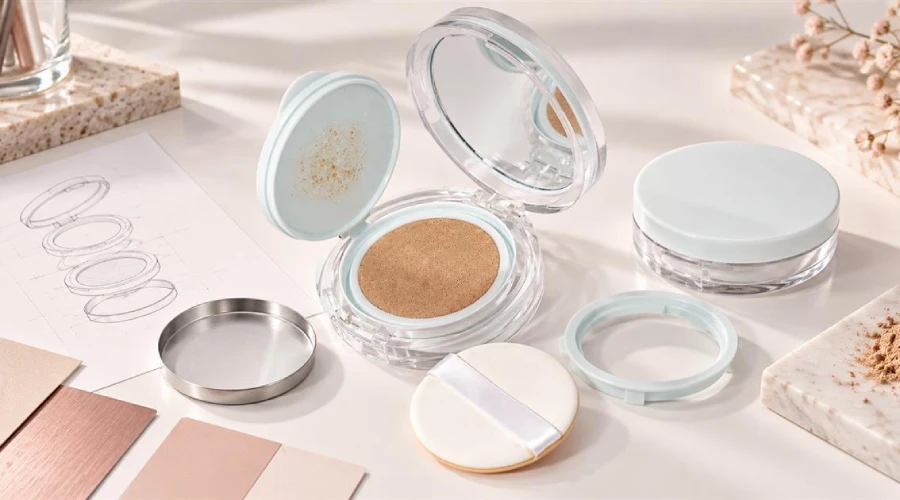
A powder compact is not simply a case around a formula. It is a component system that must hold the pan, protect the powder cake, open and close consistently, present the product, store any applicator, support decoration, and fit the intended filling and assembly process.
For pressed powder, blush, bronzer, highlighter, and eyeshadow projects, compact development should begin before the final artwork stage. The formula, pan, insert, closure, mirror, applicator, and decoration need to be reviewed together rather than approved as independent purchases.
Start with the product format and use case
Define what the compact must do. A travel setting powder with a puff, a single-pan blush, a premium baked bronzer, and a multi-shade eyeshadow palette have different structural needs.
- Is the product conventionally pressed, baked, poured, or another powder format?
- Is it applied with a brush, puff, sponge, or fingertip?
- Will it be used at home, carried daily, or sold as a professional product?
- Does the product need a mirror or applicator compartment?
- How many pans and shades are included?
- What retail positioning and decoration level are intended?
- Which markets, channels, and order scope are planned?
If the product route is not yet defined, compare baked and conventionally pressed powder formats before locking the package.
Map the compact as a complete component system
A typical compact can include an outer lid, base, hinge, latch or closure, mirror, insert or platform, pan, applicator, applicator well, inner cover, window, label, decoration, and secondary carton. Not every project needs every part, but each selected part changes dimensions, assembly, cost, appearance, and use.
Create a component list with supplier code, material, color, dimensions, cavity or pan specification, finish, decoration area, assembly method, and approval status. Avoid describing the package only by an image or external dimensions.
Select the pan with the formula and process in mind
The pan holds the product during filling or pressing and supports it throughout distribution and use. Review:
- material and surface condition;
- diameter or length and width;
- depth, wall shape, and corner radius;
- flatness and dimensional tolerance;
- retention or attachment method;
- compatibility with filling, pressing, or placement equipment;
- fit and support inside the insert.
The visible pan size also affects pickup and applicator access. Small or deeply recessed pans may limit brush movement, while thin dividers can influence palette usability and product protection.
The powder cake and pan should be evaluated together. Read the guide to pressed powder formulation and pan performance before treating cake strength as a packaging-only problem.
Confirm how the insert supports and retains the pan
The insert establishes the pan layout and its position within the compact. It can use adhesive, mechanical retention, magnets, or another project-specific assembly. Review the intended assembly method, pan removal policy, clearances, support under the pan, edge exposure, and the risk of movement or rattle.
For refillable or removable-pan concepts, define how the user or retailer identifies, removes, and replaces the pan. A refill claim should not be based only on visual removability; the complete refill system and market communication need deliberate planning.
Evaluate closure, hinge, and clearances
The compact should open and close as intended without contacting or damaging the powder surface. Check hinge movement, opening angle, latch engagement, opening force, gap consistency, and repeated handling. Ensure the lid, mirror, inner cover, applicator, and powder dome or embossing have adequate clearance.
A closure can feel acceptable when empty but behave differently after filling, decoration, assembly, or transport. Review production-intent samples rather than relying only on an early appearance model.
Decide whether a mirror supports the product
A mirror can improve portable use and premium presentation, but it adds space, weight, assembly, cleaning, protection, and inspection requirements. Define mirror size, position, attachment, edge treatment, protective film, reflection quality, and clearance.
If the product is normally applied with a large brush at home, a small mirror may add complexity without improving the experience. Make the decision from the product use case rather than category convention.
Match the applicator to the powder and package
The applicator affects pickup, payoff, blending, hygiene expectations, and package layout. A puff, sponge, brush, or dual-ended tool can make the same powder feel different in use.
Confirm applicator dimensions, material, density or fiber direction, ribbon or handle, storage position, removal access, and contact with the product. Test it with the intended powder cake, not only as a loose component. If the brand expects consumers to use their own brush, decide whether including a small applicator adds real value.
Choose stock, semi-custom, or custom structure deliberately
A stock compact can reduce structural development work, while color, finish, decoration, insert, or carton choices may still create meaningful customization. A custom mold can support a distinctive shape or mechanism but introduces additional development, tooling, validation, and commercial decisions.
AKIACO’s shared project context confirms that custom mold development is available and that mold cost is the customer’s responsibility; exact mold cost and lead time remain project-specific. Use the stock versus custom cosmetic packaging guide to select the route before finalizing the brief.
Plan decoration from the real surface
Color injection, coating, metallization, screen printing, hot stamping, labeling, embossing, texture, or other finishes interact with the component material and geometry. Curves, recesses, hinges, parting lines, and small printable areas can limit artwork.
Approve decoration on the intended material and structure when appearance is important. Screen PDFs can confirm layout but cannot always represent metallic reflection, opacity, coating texture, or distortion across curved surfaces. Use the cosmetic packaging artwork approval checklist before authorizing print or decoration.
Review the compact with the final formula
A component sample and a formula sample can each pass separate reviews but fail as a finished system. The final review should consider product contact where applicable, fit, filling or pressing, closure, surface clearance, applicator interaction, label or decoration behavior, filled appearance, handling, and the project’s transport and storage checks.
The specific test plan depends on product, material, market, supply chain, and risk. Do not assume one universal drop height, cycle count, or storage condition applies to every compact.
Use a staged compact approval process
| Stage | Primary decision |
|---|---|
| Concept | Product format, pan count, portability, mirror, applicator, and retail direction |
| Structure | Dimensions, materials, pan/insert, hinge, latch, and clearances |
| Appearance | Color, finish, decoration, artwork area, and assembled presentation |
| Filled sample | Formula, pan, compact, applicator, closure, and presentation as one system |
| Production release | Controlled component, artwork, formula, sample, open items, and approval record |
Record whether each approval covers appearance, structure, function, decoration, formula fit, or the complete filled product. Avoid the broad statement “compact approved” when only one layer has been reviewed.
Information to include in a compact development brief
- product format, shade count, finish, and pan plan;
- target compact dimensions and portability needs;
- stock, modified-stock, or custom route;
- mirror, applicator, window, refill, or inner-cover requirements;
- material, color, surface finish, and decoration direction;
- secondary carton and market requirements;
- formula and pan status;
- order scope, target market, and approval owners;
- benchmarks and non-negotiable functions.
Use the pre-production makeup sample approval checklist to control the final formula, pan, compact, artwork, and open items. When your component brief and product status are ready, contact AKIACO to discuss sourcing, samples, and the appropriate development route.
Frequently asked questions
What should be selected first for a powder compact project?
Define the product format and user experience first, then align the pan, insert, compact structure, applicator, decoration, and testing plan.
Does every powder formula fit every compact?
No. Powder behavior, cake strength, pan dimensions, retention, clearance, applicator, and package protection must work as one system.
Should a powder compact include a mirror and applicator?
Only when they support the intended use, retail position, package size, hygiene plan, cost structure, and user experience.
When should decoration be approved?
Approve decoration after the structure, material, printable area, artwork, color reference, and relevant proof or sample are controlled.
What should be checked on a compact sample?
Check pan fit, closure, hinge, mirror, applicator storage, clearances, decoration, assembly, powder protection, and filled-product presentation.