
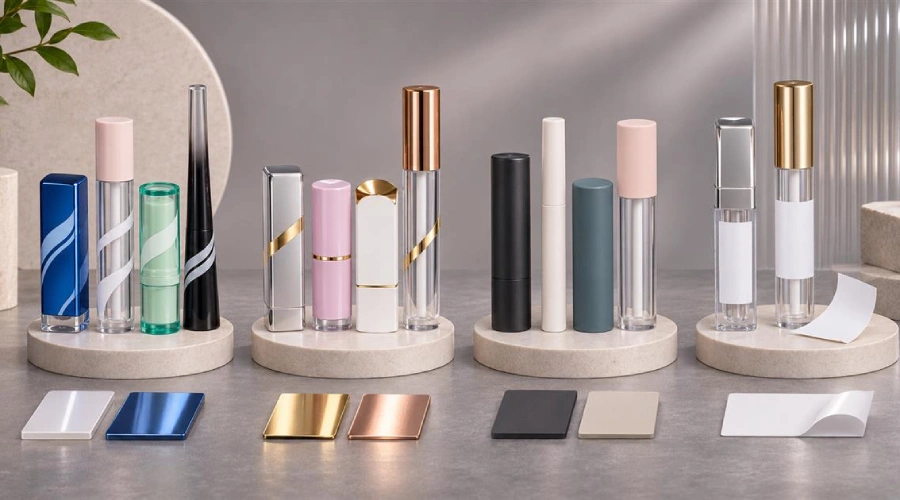
Decoration turns a standard cosmetic component into a recognizable branded package, but the choice is not purely visual. The same artwork can behave differently when printed on a flat carton, a curved lip-gloss tube, a soft plastic bottle, or a coated compact.
Beauty brands should select the decoration method together with the exact component, material, shape, artwork, finish target, proof route, and order plan. A finish chosen from a mood board is only a direction until feasibility is confirmed on the real package.
Start with the component, not the decoration name
Before comparing methods, define the package route and the surfaces that will carry the artwork. Confirm the component code, substrate, color, curvature, seams, closures, print area, handling points, and any secondary carton or label.
If the structure is still open, compare stock, semi-custom, and custom cosmetic packaging first. Decoration cannot solve a mismatch between the component and the product concept.
Screen printing
Screen printing transfers ink through a prepared screen onto the package. It is commonly considered for logos, short text, lines, and spot-color graphics on suitable areas.
Buyers should confirm the printable area, number and sequence of colors, ink and substrate pairing, opacity, registration, curvature, and sample-review method. A design that is simple on a flat file may be difficult to align around a narrow tube or close to an edge.
Useful when: the design uses controlled spot-color graphics and direct decoration supports the desired presentation.
Questions to ask: What area can be printed? How will color and registration be approved? What physical checks apply to the decorated component?
Pad printing
Pad printing transfers ink with a flexible pad and may suit smaller or more complex surfaces. It can be considered for compact details, caps, curved components, or areas that are difficult to reach with another direct-printing method.
Confirm the actual image size, surface geometry, color count, edge distortion, alignment, and the way the component will be held during decoration. Do not assume that a method used on one component will produce the same result on another material or shape.
Hot stamping and foil accents
Hot stamping applies a foil or transfer layer using a die, pressure, and controlled process conditions. It is often selected for metallic or high-contrast accents, but the result depends on the foil, substrate, shape, design, support, and available stamping area.
Fine details, sharp edges, deep curves, joints, and large solid areas can create different feasibility questions. Review the die area, foil reference, placement, edge quality, coverage, and sample under the lighting in which the package will be evaluated.
Spray coating and soft-touch finishes
Coating changes the visible color, gloss, and feel of a component. It can create matte, glossy, translucent, gradient, or tactile directions depending on the process available for the selected package.
Specify the color and surface target, masked areas, gloss or texture direction, interaction with later printing or stamping, and the physical sample that will control approval. Coating can change how later colors appear, so the full decoration sequence matters.
Metallization and metallic-looking surfaces
Metallized finishes can create reflective or premium-looking surfaces across a component or selected area. The buyer should define the intended hue, reflectivity, masked zones, topcoat or later decoration, and tolerance for visible variation.
A metallic reference viewed on screen is not enough. Approve a physical sample on the actual substrate and check it with the complete component set.
Pressure-sensitive labels
Labels can support detailed graphics, several colors, variable information, market versions, and shorter artwork changes without directly decorating every component. They also introduce decisions about label material, adhesive, shape, edge, overlap, transparency, application position, and compatibility with the package surface.
Review the label on the filled or representative component where possible. Curvature, squeezing, oils, moisture, temperature, and handling may affect the appropriate evaluation plan.
Sleeves and wraps
Sleeves or wraps can provide a larger graphic area and may also support tamper or multipack functions depending on the design. Confirm the material, seam, shrink or application behavior, distortion around curves, code zones, perforation, and impact on opening or recycling instructions.
Decorated cartons and secondary packaging
Cartons offer additional print and finish options such as process printing, spot colors, foil, embossing, debossing, varnish, texture, and windows. The carton should be developed as part of the full packaging system, not as an isolated design surface.
Confirm structural dieline, board, print method, finish layers, barcode area, glue zones, folds, opening direction, and how the primary package sits inside.
Decoration-method comparison
| Method | Typical visual role | Buyer checks |
|---|---|---|
| Screen printing | Direct spot-color graphics | Area, ink/substrate, opacity, registration, curvature |
| Pad printing | Small or shaped-surface details | Geometry, distortion, fixture, alignment |
| Hot stamping | Metallic or contrast accent | Foil, die, support, edges, coverage, placement |
| Coating | Overall color, gloss, or tactile finish | Color, masking, texture, sequence, later decoration |
| Metallization | Reflective surface | Hue, reflectivity, masked zones, topcoat |
| Label or sleeve | Detailed or variable graphics | Material, adhesive/seam, curvature, position, handling |
Build a decoration brief
A useful brief includes:
- exact component and material reference;
- artwork file and intended decoration area;
- color, gloss, texture, foil, and physical references;
- SKU list and order allocation;
- intended markets and variable artwork needs;
- proof and sample route;
- review conditions and approval owners;
- open feasibility questions.
Once the method and component are confirmed, use the cosmetic packaging artwork approval checklist to control dielines, files, versions, proofs, and final release. Keep decoration approval separate from formula-to-package compatibility evaluation.
Choose by project fit, not by a universal ranking
No decoration method is automatically the most premium, durable, flexible, or economical for every package. The right choice is the route that can reproduce the approved design on the selected component, at the intended order scope, with a clear sample and approval plan.
To discuss a cosmetic package, contact AKIACO with the product format, component reference, artwork direction, intended finish, target markets, SKU count, and order scope. Decoration feasibility and project terms should be confirmed for the exact package.
Frequently asked questions
What are common cosmetic packaging decoration methods?
Common routes include screen or pad printing, hot stamping, coating, metallization, labels, sleeves, and decorated cartons.
Is screen printing or hot stamping better for cosmetic packaging?
Can the decoration method be chosen before the component?
Does a digital artwork proof approve the final decoration?
No. It can confirm layout, but the actual material, curvature, color, gloss, adhesion, and registration may require a physical sample.
What should a decoration brief include?
Include the exact component, artwork, color and finish references, decoration area, proof route, review criteria, SKU quantity, and intended market use.